
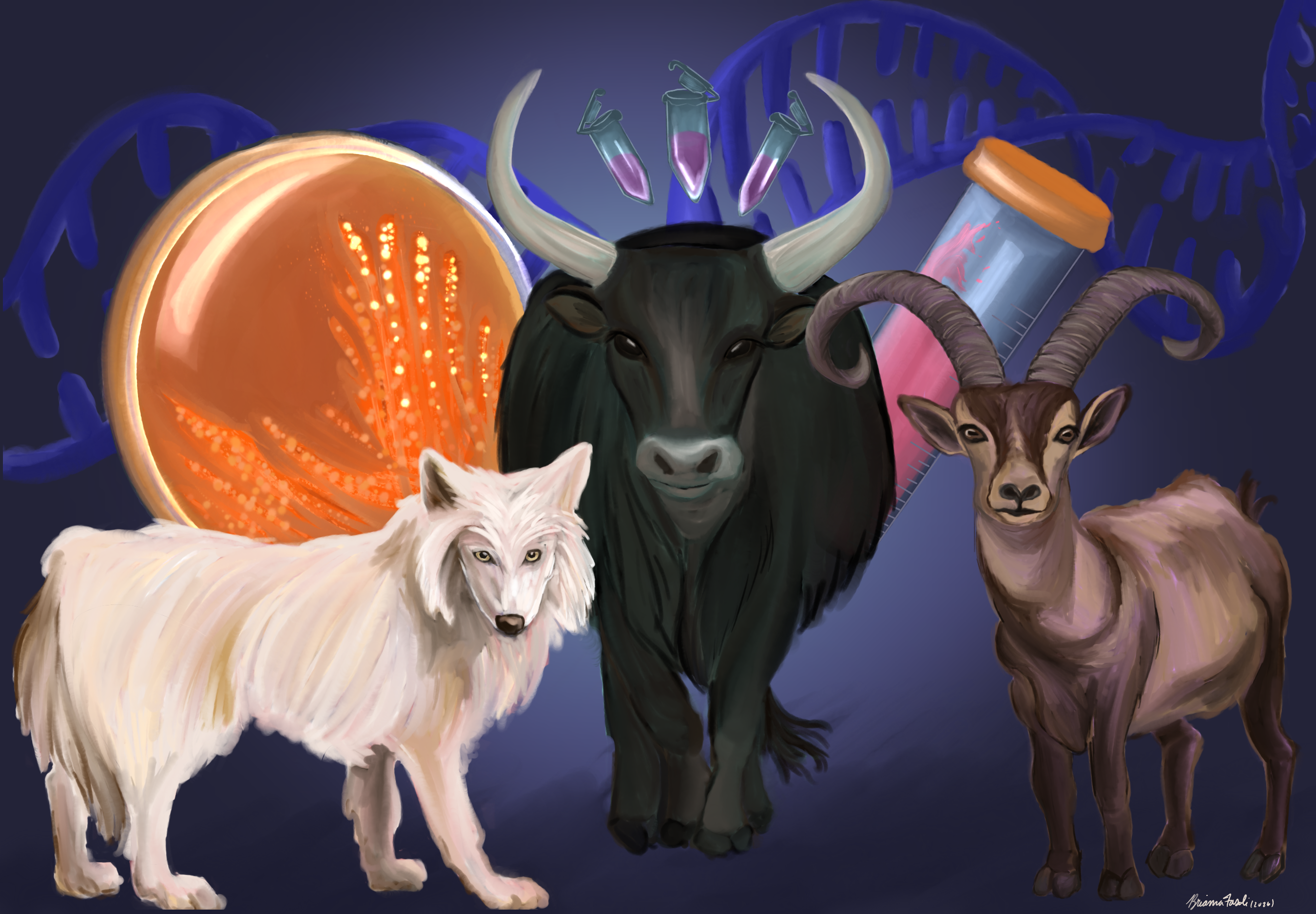
Cover Image: Brianna Fasoli, March 2026
By: Becca Carballal, Contributing Writer
The possibility of bringing extinct animals back from the dead has captured the imaginations of science fiction enthusiasts for decades. Yet even though it may seem that the Jurassic Park franchise provided us with a more-than-fair warning about what the realization of this technology could entail, conversations about the implications of de-extinction continue to move further from the world of fiction and closer to reality.
With well over 10,000 species dying out each year, we are in the midst of what many ecologists consider to be Earth’s sixth major extinction event [1]. This massive loss of biodiversity is concerning not just because we are losing unique species born out of millions of years of evolution, but, more alarmingly, because each one of these losses has a devastating cascade of ecological consequences. Food webs are disrupted, invasive species are more easily able to dominate ecosystems, and ultimately, vital natural resources relied upon by animals and humans alike are threatened [2].
De-extinction refers to the use of biotechnology to create organisms that resemble these extinct species. By its biggest proponents, it has been touted as a means of reversing this environmental damage. Thus, the goal of de-extinction is not, in most cases, to bring back exact genetic copies of organisms that have died out, but rather to create a very similar creature that can fill the empty ecological niche [3]. In many cases, this means that scientists are also attempting to make improvements to the genomes of extinct species to prevent them from meeting the same fate as their ancestors [4]. While these efforts have yet to yield us the means necessary to construct a real-life dinosaur theme park, some significant results have still been achieved [1].
Three Ways to Bring Back the Dead:
To create species that can fill these empty niches, researchers have explored three primary methods. The first, and most straightforward, employs a cloning technique called somatic cell nuclear transfer (SCNT). This process involves taking a donor nucleus from a somatic cell of the organism to be cloned and implanting it into the unfertilized egg cell of a different individual. This creates an embryo that is genetically identical to the donor organism from which the nucleus was taken. That embryo is then carried to term by a surrogate mother. SCNT found brief success as a means for de-extinction with the revival of the Bucardo in 2003. The Bucardo, also known as the Pyrenean ibex, had been hunted to extinction three years prior, but by transferring the creature’s preserved nucleus into the egg cell of a domestic goat, researchers were able to de-extinct the animal… for a total of three minutes. Unfortunately, it died soon after birth due to a severe lung defect [5].
The primary issue with SCNT (besides its low success rate of actually producing viable offspring) is that it requires scientists to have a fully preserved nucleus of the extinct species they hope to revive. This is far from guaranteed when it comes to most extinct animals. For organisms like the Bucardo that died out more recently it is not a problem, but a cell’s nucleus degrades quickly. For species that have been extinct for longer periods of time, before the technology necessary to preserve cells was even invented, obtaining a nucleus that could be used for SCNT is impossible [3].
The next de-extinction method scientists are exploring builds off previous uses of SCNT, but the addition of a new technology to the process allows it to escape previous temporal limitations. Rather than relying on fully preserved DNA samples from extinct species, researchers instead use CRISPR gene editing technology to modify the genome of its most closely related extant ancestor. To accomplish this, scientists analyze the genomes of both the extinct and the extant species and identify the key differences in their DNA. These sequences where these differences occur then serve as the locations where editing must take place. At each of these sites, CRISPR technology, a high precision gene editing technique, allows scientists to swap in the genes of the extinct species for the genes of the extant. Similarly to what was done with the Bucardo, SCNT is then used to implant the edited genome into an egg cell of the extant species that can carry it to term [6].
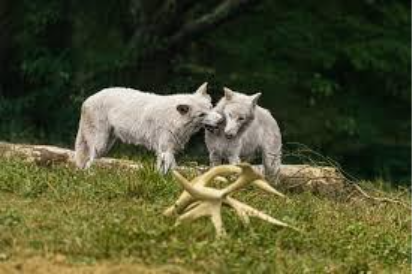
This combination of CRISPR and SCNT has yielded us one of the most famous de-extinction efforts to date: Colossal Bioscience’s revival of the dire wolf. Dire wolves, which went extinct around 10,000 years ago, are essentially just larger, more muscular versions of the gray wolves we know today. On October 1, 2024, Colossal announced the birth of two new dire wolves: creatures that resulted from 20 key genetic edits to the gray wolf genome [2]. The pups, named Romulus and Remus after mythic twins whose story tells the founding of Rome, are still alive today. Despite this apparent success, many scientists argue that Colossal’s claims of successful de-extinction are far overblown. In their eyes, Romulus and Remus are much more akin to the common grey wolf regardless of the changes Colossal was able to make to their outward appearances. [6].
This claim gets at the heart of why any de-extinction efforts utilizing SCNT will never be completely accurate. As its name implies, SCNT only allows for substitution of genetic information stored in the nucleus. Mitochondrial DNA, which encodes an organism’s metabolic functions, still matches the extant organism. Although mitochondrial DNA only comprises a very small part of the genome, it still prevents any creature produced with SCNT from being an exact genetic match. This combined with the fact that any animal born from a surrogate of different species is bound to lack an authentic replica of the maternal care and socialization it otherwise would have received, makes any claim of complete de-extinction difficult to defend [2].
The final route researchers have taken aims to tackle de-extinction from an entirely different angle. Through a technique called back-breeding, researchers are attempting to selectively mate the living descendants of an extinct species in order to select traits that the common ancestor possessed [7]. Although it is considerably less flashy than the other technologies discussed, back-breeding has still seen some success, most notably by the Tauros Programme. This initiative is aiming to create a proxy for aurochs, the ancient wild ancestors, to all domestic cattle. Aurochs make a good target for this strategy because they have a wide array of living descendants, each of which carries its own unique pieces of the original auroch genome [8].
Through repeated breeding processes and DNA sampling of the resulting offspring, researchers have successfully created a species that can survive in the wild. This creature, dubbed the Tauros, was released into the wilderness of both Portugal and Scandinavia in 2025. Although it is not an exact replica of the auroch, the Tauros does fulfill the project’s goal of re-introducing a wild grazing species to these grasslands ecosystems. Since the release is recent, it remains to be seen how successful this initiative will be in the long term [8].
Fiction Becomes Reality, But at What Cost?
Despite the many efforts researchers have poured into these various methods for de-extinction, the topic as a whole still remains incredibly divisive, both within the scientific community and beyond. The concerns raised range from a practical ecological level all the way to a deeply philosophical one, but the most common complaint relates to resource allocation.
Initiatives that combat climate change and preserve our wilderness are universally underfunded. As a result, many people who work in these spaces believe that the time and money being poured into de-extinction research is coming directly out of a pool that would have otherwise gone towards conservation efforts [9]. Definitive proof of the ecological benefits of de-extinction projects remains to be seen, and even if it does turn out to be helpful, there will still be many years until the positive impacts are observed. By devoting large portions of our conservation efforts to de-extinction, we are placing a bet on technologies whose benefits remain to be seen, and in doing so, losing precious time to invest in methods already proven to work.
A second argument against de-extinction asserts that the release of human-engineered organisms in the wild has the potential to be incredibly dangerous. While there is no way of knowing for certain how a de-extinct species will affect an ecosystem, the lack of predictability presents a problem in and of itself. Once a species is released, the decision cannot be unmade. Although it is very unlikely that any de-extincted animal would become a direct threat to humans, it is possible that it could become invasive, outcompeting local species or disrupting the food web in entirely unforeseen ways. This outcome would ultimately lead to net decline in biodiversity which, ironically, is the very problem de-extinction is attempting to solve [10].
The last critique of de-extinction is a moral one. Many people argue that de-extinction efforts are simply projects of vanity guised as environmental initiatives. This grievance was highlighted particularly by discourse around the attempt to de-extinct the Burcardo, with local conservationists from the Pyrenees region bluntly stating that the scientists only wanted fame and success [5]. While it may not be possible to address this claim, the fact that the most successful de-extinction efforts to date have focused on the revival of giant wolves named after Roman kings and an ibex coveted by trophy hunters for its horns has left the true motives of de-extinction efforts up for question.
References
- Rodrigo Béllo Carvalho. (2025). Between hype and hope: De-extinction is a tool, not a panacea for the biodiversity crisis, Biological Conservation, Volume 309, https://doi.org/10.1016/j.biocon.2025.111307.
- Cohen, S. (2014). The Ethics of De-Extinction. Nanoethics 8, 165–178 https://doi.org/10.1007/s11569-014-0201-2
- Stephen D Turner, Anna Keyte, Andrew Pask, Beth Shapiro (2025). De-extinction technology and its application to conservation, Journal of Heredity, https://doi.org/10.1093/jhered/esaf069
- Colossal Biosciences. “Direwolf – Colossal.” Colossal, 7 Apr. 2025, colossal.com/direwolf/.
- Searle, A. (2022). Spectral ecologies: De/extinction in the Pyrenees. Trans Inst Br Geogr., 47, 167–183. https://doi.org/10.1111/tran.12478
- Callaway, E. (2025). This company claimed to “de-extinct” dire wolves. Then the fighting started. Nature News. https://www.nature.com/articles/d41586-025-02456-3
- Shapiro, B. (2017), Pathways to de-extinction: how close can we get to resurrection of an extinct species?. Functional Ecology, 31: 996-1002. https://doi.org/10.1111/1365-2435.12705
- Rewilding Europe. “Tauros.” Rewilding Europe, rewildingeurope.com/rewilding-in-action/wildlife-comeback/tauros/.
- Bennett, J., Maloney, R., Steeves, T. et al. (2017). Spending limited resources on de-extinction could lead to net biodiversity loss. Nat Ecol Evol 1, 0053, https://doi.org/10.1038/s41559-016-0053
- Piero Genovesi, Daniel Simberloff, (2020). “De-extinction” in conservation: Assessing risks of releasing “resurrected” species, Journal for Nature Conservation,Volume 56, https://doi.org/10.1016/j.jnc.2020.125838.

 The Abstract