
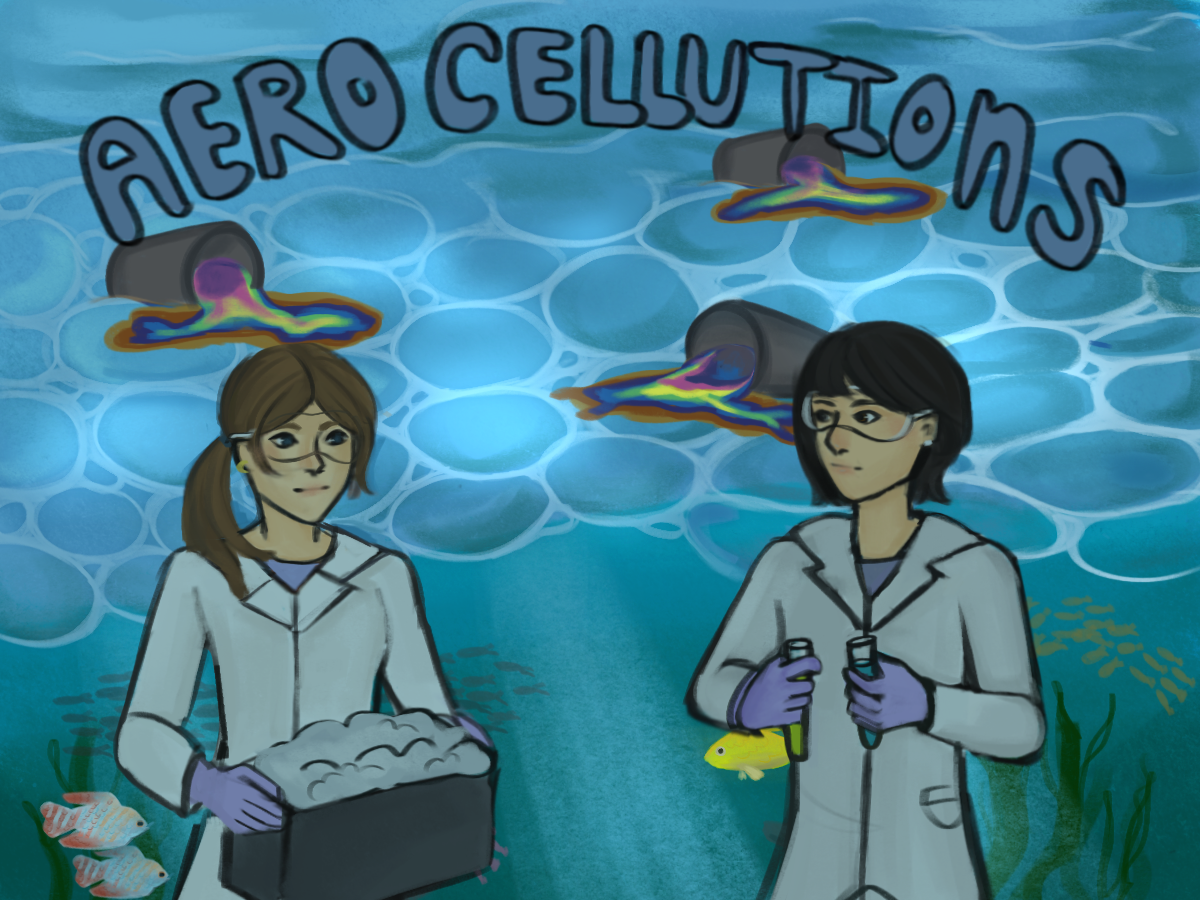
Cover Image: Charlotte Benard, March 2026
What does a smoothie maker, Dolly the sheep, and isopropyl alcohol all have in common? They’re all vital components of McGill BioDesign’s latest project, AeroCellutions!
Made up of 22 undergraduate students, the team at AeroCellutions is focused on creating a sustainable, practical, and cost effective solution to oil spill remediation. It may sound bizarre, but cleaning up oil spills can actually lead to more pollution. This is because the products used to absorb the oil are made of plastic – a notoriously non-degradable material.
In 2024, at least 1,009 marine oil spills occurred in Canada, with estimates of 739 liters spilled in total. Oil spills can have a devastating impact on surrounding communities; most of the chemicals involved are classified as type 1 carcinogens. Unfortunately, the sorbent materials used to clean up oil spills are made of plastic, and thus are not degradable. One alternative solution is to use biological materials like hair and plant fibers, but these alone are not selective enough for oil, as they absorb large amounts of water too. The problem becomes a logistical one; if the sorbents sink, they are difficult to retrieve, and the longer they remain in the water, the more contaminated the water becomes. Decontamination of the water is the greatest cost to cleaning up oil spills, meaning that sorbents not only have to absorb a lot of oil, but they have to absorb that oil fast, and be removed quickly.
The most obvious solution is to render the biological materials hydrophobic, so that they repel water and only absorb oil. This is where AeroCellution has identified a gap in the research. Most studies use silanization techniques, wherein organosilanes react with hydroxyl-rich surfaces, forming covalent bonds between the silicon of the coating molecule and the oxygen of the material’s surface (i.e. siloxane bonds). Chlorosilanes are a popular choice, because they are highly reactive and thus speed up the coating process so that it can be completed within minutes. Not only does this make the fabrication process easier, it also ensures complete coverage of porous surfaces.
Using silanization techniques, some researchers have been able to produce materials that out-perform the plastic sorbents currently on the market. However, these studies often leave out one crucial detail – silanized surfaces are resistant to degradation. This undermines the whole point of using a biological material. AeroCellutions, on the other hand, understands that biodegradability is just as important as oil absorptivity, and is thus investigating alternative coatings methods.
The process begins with Dolly the sheep, a resident at PACE Farm in Ile-Bizard. The wool from her coat is washed and dried, and then added to an aqueous solution of cellulose that’s been blended in a smoothie maker. The mixture is drained and immersed in isopropyl alcohol, to which a sizing agent is added. Hydrophobic groups are covalently linked to the surface of the cellulose, and the entangled wool fibers form a secure network, keeping everything together. The final product is tested on petroleum recovered from a real oil spill, courtesy of Urgence Marine Environment, an oil spill response company located in Montreal.
This work is an important reminder that sustainability is a complex issue even in the field of environmental remediation, but it is nonetheless necessary to challenge the status quo.
This summer, AeroCellutions will be presenting their work at the BioDesign Challenge, a biotechnology competition held annually at the Museum of Modern Art in New York City. Their progress can be followed on instagram, at aerocellutions.mcgill.

 The Abstract