
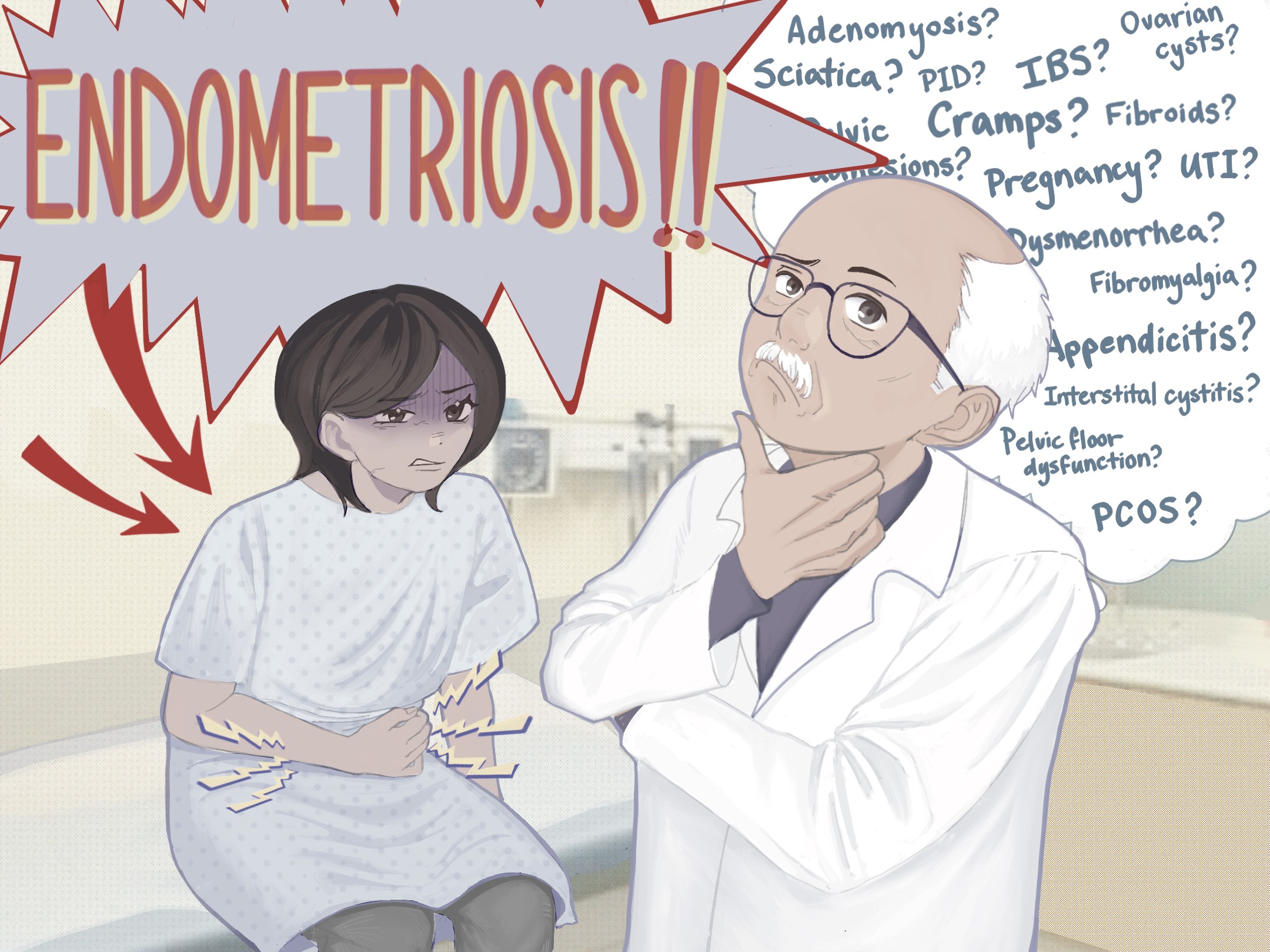
Cover Image: Jenny Ding, March 2026
By: Isla Stiff, Contributing Writer
Happy International Women’s Day!
There remains a widespread perception that menstruation is shameful and even repulsive, a stigma that leads those who menstruate to conceal pain along with related symptoms from medical professionals, friends, and colleagues (1). I am here to tell anyone who is struggling with debilitating, painful periods that it is not normal. The widespread dismissal of severe menstrual pain delays diagnosis and treatment for individuals who are likely living with endometriosis (1). Encouragingly, new diagnostic methods for endometriosis are currently being developed – offering hope for earlier detection and improved care.
I am sure many readers have heard the word endometriosis. Maybe your friend has the condition, or your mom. Endometriosis is being used increasingly in public conversation – but what does the condition actually involve?
Endometriosis is a chronic gynecological condition affecting individuals that menstruate during their reproductive years, arising from a combination of environmental and genetic factors (2). In fact, about 51% of the risk of developing endometriosis is attributed to genetic factors (2). Endometriosis occurs when cells that are supposed to grow inside the uterus – known as endometrial tissues – instead grow outside, affecting the fallopian tubes, ovaries, bladder and intestines (2). When individuals with endometriosis menstruate, endometrial fragments break down outside the uterus, resulting in chronic inflammation with formation of patches of endometrial tissue outside the uterus, known as lesions (3) . Additionally, adhesions form on organs, which are bands of scar tissue that form due to inflammation (3).
The condition is commonly associated with severe pelvic pain, severe period pain (dysmenhorrhea), and infertility (2).
It is necessary to acknowledge that endometriosis is very common, affecting 1 in 10 menstruators of child bearing age globally (4). However, the condition continuously remains underdiagnosed (5). Diagnostic delays are due to a multitude of factors- one of the most significant being the absence of a standardized, non-invasive method to detect endometriosis within clinical practices. Diagnosis and treatment varies based on the stage of the endometriosis (5). Traditionally, laparoscopy has been considered the “Gold Standard” for both diagnosis and treatment. Diagnostically, laparoscopy involves the examination of the abdominal cavity using a small camera (5). Surgical interventions destroy endometrial lesions and then excise these lesions in hope to reduce pain and infertility (6). However, as surgery is invasive and not suitable as a universal diagnostic approach, clinicians often rely on nonsurgical methods. Methods of nonsurgical diagnosis include combination of symptoms, signs and ultrasonographic findings (5). Pharmacological treatment is symptomatic and not cytoreductive, meaning that care such as hormonal contraceptives (birth control, IUD’s) focus on relieving symptoms without removing the diseased tissue (6).
De Corte and collaborators found that it takes on average 1-4 years for individuals that have onset symptoms of endometriosis to seek medical attention (5). Why is there such a delay in primary diagnosis? The delay is due to the acceptance of dysmenorrhea and the social taboo of period discomfort, which leads to normalisation of symptoms by the patient (1). The study also found that it can take up to 8.6 years between the initial consultation and receiving a confirmed diagnosis, primarily because clinicians also normalize dysmenorrhea (5). Additionally, endometriosis has both diverse symptoms and different stages based on the depth and placement of lesions, making it difficult to standardize a diagnostic method (5). The delay in primary and clinical diagnosis contributes to potentially worsening symptoms of the patient, impaired quality of life, and increased healthcare costs (5).
To address disparities in clinical diagnosis of endometriosis, international organizations such as The World Health Organization (WHO) and The World Endometriosis Society (WES) have published diagnostic guidelines (5). These guidelines aim to increase awareness about endometriosis diagnosis criteria and reduce misdiagnosis (for example, endometriosis is often misdiagnosed as irritable bowel syndrome or ovarian cysts) (5) . The guidelines may lead to earlier recognition of endometriosis in affected individuals. Despite advances in clinical diagnosis, there are still long delays between symptom onset and diagnosis, highlighting the continued need to increase awareness and improve access to diagnostic resources among healthcare providers (5).
Recently, the search for a biological sign of endometriosis that can be detected without invasive procedures (also known as a biomarker) has become a priority in addressing the diagnostic delay and achieving a standardized diagnostic test for endometriosis (7).
One potential biomarker being explored to diagnose endometriosis is microRNA (miRNA). Naturally found in the body, miRNAs are short RNA molecules that have high stability in blood and tissue, making them promising candidates for medical tests (8). These molecules attach to messenger RNA (mRNA), the molecule that carries instructions for making proteins. When miRNA binds to mRNA, it inhibits the mRNA to be translated into a protein, controlling the amount of a specific protein being produced (8). This process, called post-transcriptional gene regulation, regulates normal physiological functions, such as cell growth and development (7). However, changes in miRNA activity can contribute to disease, including inflammatory ones like endometriosis (7). With new tools, researchers can observe which specific miRNAs are found in the blood, and deduce if their concentration is present in different levels than normal. In fact, specific miRNAs tend to be consistently increased or decreased in people with endometriosis compared to others without the disease (8). For example, miRNA regulates the HOXA9 gene which encodes a transcription factor that plays a crucial role in embryonic development. There is a change in HOXA9 mRNA levels in endometriosis when compared to healthy individuals (7). As a result, miRNAs have gained significant interest as potential non-invasive biomarkers. However, current miRNA biomarker studies depict poor reproducibility (7). While promising, miRNAs as biomarkers are not clinically ready diagnostic tools for endometriosis.
In addition to miRNA research, E.M. Schoeman and others identified a panel of novel plasma protein biomarkers of endometriosis. The study developed a non-invasive blood test for endometriosis using a proteomics workflow, or a method used to identify and measure proteins in a biological sample (9). They identified a panel of 10 plasma protein biomarkers for endometriosis validated in a large cohort of 749 women (9). All identified biomarkers are biologically relevant to endometriosis pathophysiology, involving immune regulation, tissue remodeling, and coagulation (9). The study also discovered that different biomarkers can be used to distinguish specific stages of endometriosis. Although the study’s findings support the clinical potential of a reliable non-invasive diagnostic tool, further validation across diverse populations is required (9).
Diagnostic delays in endometriosis continue to impose significant physical, emotional and economic burdens on affected individuals (10). This is reinforced by the societal and clinical normalization of menstrual pain and inconsistent diagnostic practices across healthcare systems (5). Although WHO and WES are developing international diagnostic guidelines and advances in non-invasive biomarker research, such as miRNA and plasma protein panels, barriers to timely diagnosis still remain.
Improving outcomes will require continued validation of emerging biomarkers alongside improved clinical recognition of endometriosis in contrast to other instances of pelvic pain. Just as importantly, social attitudes matter: when individuals with uteruses perceive discussions about menstruation as uncomfortable or unproductive they are less likely to speak up about their symptoms (1). Destigmatizing conversations around menstruation and challenging the myth that debilitating period pain is normal are crucial steps to earlier diagnosis, better care, and improved quality of life (1).
References
- APA PsycNet. Apa.org. Published 2025. https://psycnet.apa.org/fulltext/2026-08568-001.html
- Vercellini P, Viganò P, Somigliana E, Fedele L. Endometriosis: pathogenesis and treatment. Nature Reviews Endocrinology. 2013;10(5):261-275. doi:https://doi.org/10.1038/nrendo.2013.255
- Imperiale L, Nisolle M, Noël JC, Fastrez M. Three Types of Endometriosis: Pathogenesis, Diagnosis and Treatment. State of the Art. Journal of Clinical Medicine. 2023;12(3):994. doi:https://doi.org/10.3390/jcm12030994
- Li W, Feng H, Ye Q. Factors contributing to the delayed diagnosis of endometriosis—a systematic review and meta-analysis. Frontiers in Medicine. 2025;12. doi:https://doi.org/10.3389/fmed.2025.1576490
- De Corte P, Moritz Klinghardt, von Stockum S, Heinemann K. Time to Diagnose Endometriosis: Current Status, Challenges and Regional Characteristics—A Systematic Literature Review. BJOG An International Journal of Obstetrics & Gynaecology. 2024;132(2). doi:https://doi.org/10.1111/1471-0528.1797
- Bafort C, Beebeejaun Y, Tomassetti C, Bosteels J, Duffy JM. Laparoscopic surgery for endometriosis. Cochrane Database of Systematic Reviews. 2020;10(10). doi:https://doi.org/10.1002/14651858.cd011031.pub3
- Dryja-Brodowska A, Obrzut B, Obrzut M, Darmochwał-Kolarz D. miRNA in Endometriosis—A New Hope or an Illusion? Journal of Clinical Medicine. 2025;14(14):4849. doi:https://doi.org/10.3390/jcm14144849
- Begum MIA, Chuan L, Hong ST, Chae HS. The Pathological Role of miRNAs in Endometriosis. Biomedicines. 2023;11(11):3087. doi:https://doi.org/10.3390/biomedicines11113087
- Schoeman EM, Bringans S, Peters K, et al. Identification of plasma protein biomarkers for endometriosis and the development of statistical models for disease diagnosis. Human Reproduction. 2024;40(2). doi:https://doi.org/10.1093/humrep/deae278
- Noditi AR, Bostan IS, Scurtu F, et al. Analysis of the Biopsychosocial Impacts Associated with Endometriosis to Improve Patient Care. Journal of Clinical Medicine. 2025;14(7):2158.

 The Abstract