
Virus particles used as gene delivery vectors by parasitoid wasps—and people?
Cover image: Signe Dixon, February 2026
By: Jacob Van Oorschot, Contributing Writer
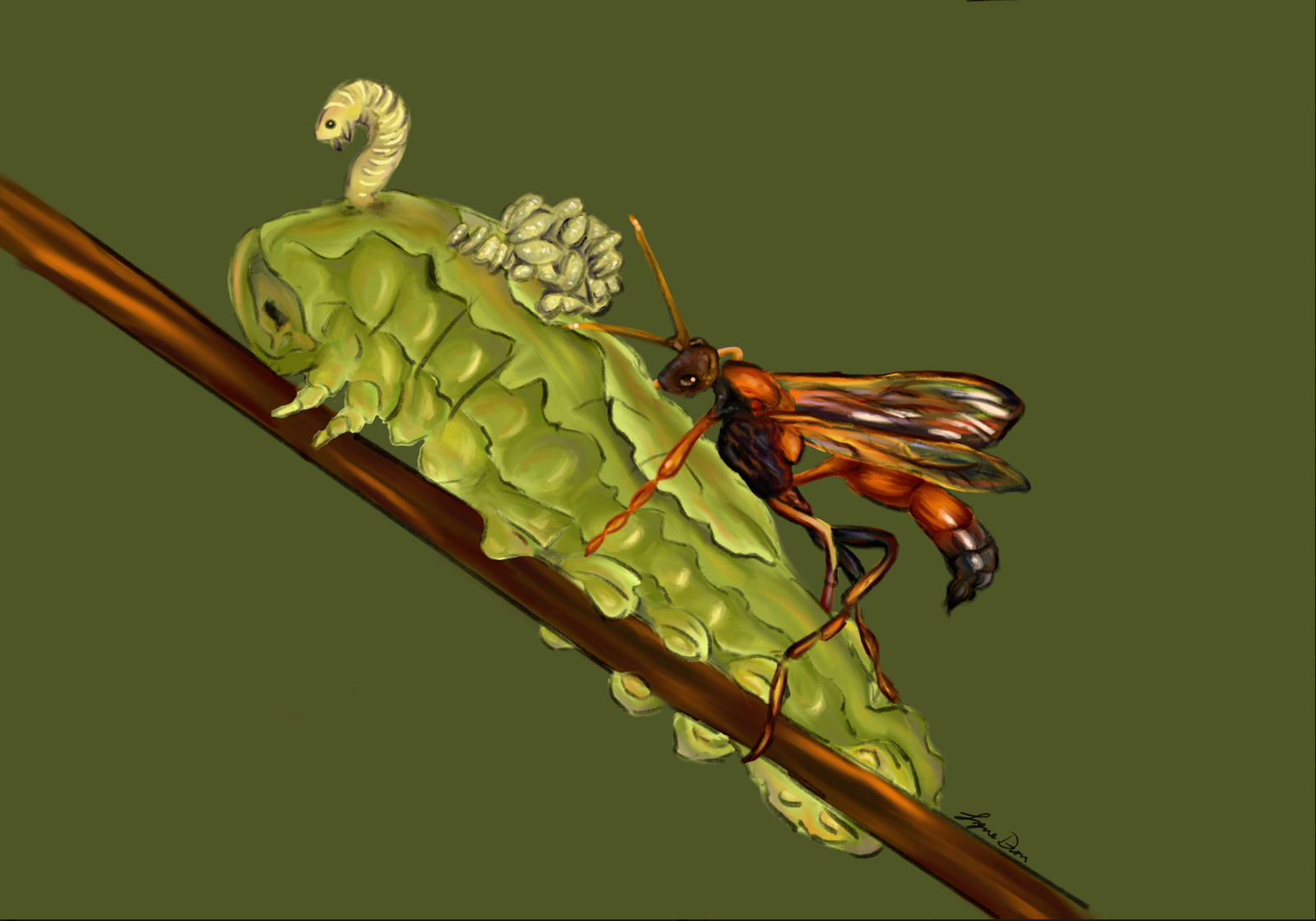
If ever you feel that you are having a difficult day, consider taking solace in the fact that you are at least not the caterpillar victim of a parasitoid wasp. The inspiration for the Xenomorphs of the Alien franchise, parasitoid wasps paralyze their victims (usually caterpillars) with a venomous sting. They then lay their eggs within such that after hatching, their offspring may eat their victim from the inside out. Adding to injury, some parasitoid wasps inject a third insult: a virus. This isn’t just some random virus hitching a ride with the wasp (as we see in, say, the viral infections transmitted by mosquitoes when they bite mammals). These viruses are in fact welcome guests in the wasp—a symbiont that helps the wasps’ eggs thrive in the host by disrupting its immune system (1).
Of course caterpillars don’t take this onslaught lying down. For one thing, they exhibit a variety of behaviour to stop the attack in the first place. When faced with a parasitoid wasp, some fight back with secretions or regurgitated material to irritate or poison their attacker (2, 3). Others wriggle and roll violently to prevent the deposition of eggs (3). But should that fail, the caterpillar immune system provides another line of defense. Presented with a foreign body, the caterpillar’s hemocytes (the equivalent of human white blood cells) gather around it to form a capsule. After encapsulation, a tough coat of melanin is deposited around the egg to sequester it, and in the process toxic molecules are produced that harm the egg (3). Failing death by toxic molecules, the egg is starved of oxygen (3).
But the arms race continues. The venom in the wasps’ sting paralyzes the caterpillar and interferes with its immune response (4). Here too, the symbiotic viruses come into play. You might be used to the idea that our immune system fights off viruses, but in this case, the opposite is true. Symbionts in the “polydnavirus,” family employed by parasitoid wasps, disrupt caterpillars’ encapsulation immune response against wasps’ eggs (3). But I get ahead of myself. How does the parasitoid wasp even acquire and control the virus in the first place?
A typical viral particle consists of a structural protein capsid that packages up genetic information (DNA or RNA) with additional functional proteins. The goal of the virus is to deliver its cargo into a new cell. Once in, this genetic information and the functional proteins hijack the cell’s resources to replicate the viral genetic information and make more proteins. This eventually produces new viral particles which can be spread to other cells. It depends on a combination of its own functional proteins alongside some of the proteins and energy in the host to achieve this end.
But in extant polydnaviruses, the viral genetic information is integrated directly into the wasp genome, and replicated alongside it. Every cell in the wasp has the genetic information needed to make polydnavirus particles, but only those in the ovaries do so (1). After all, a parasitoid wasp wants the virus deposited in a controlled manner in the caterpillar, rather than running rampant throughout its own body. So, in wasps’ ovaries, and only there, viral proteins DNA are produced and assembled into viral particles. These are deposited into the caterpillar alongside eggs. The particles infect caterpillar cells but DO NOT replicate to produce more of themselves. Instead, the DNAs they contain integrate into the caterpillar genome and are expressed as protein products. These protein products disrupt the caterpillar immune system. The types of proteins and their effects on the molecular level are varied, but on the level of phenotype, many converge on disrupting the encapsulation response (1).

Parasitoid wasps’ venom is also able to disrupt the caterpillar immune system. In fact, many parasitoid wasps don’t carry polydnaviruses, and rely on venom alone. So why do some go through the hassle of maintaining and producing a viral symbiont? It could be about efficiency. Polydnaviruses target immune cells and are integrated into the caterpillar genome (4). Once integrated they can be continually expressed. So, using a virus could save a wasp energy by allowing caterpillar immune cells to be targeted specifically, and by making the caterpillar do the hard work of expressing the genes. The other benefit could be a longer-lasting effect. Continuous expression is favourable for parasitoid wasps because their eggs can take months to develop. The effect of a venom could wear off over time, but genes integrated into the host genome can be expressed indefinitely (4).
O Brave New World
Parasitoid wasps are not the only organism to co-opt virus particles for the efficient delivery of genetic material. Gene therapies based on viral vectors have recently started to be used to treat human diseases. Here, as was with polydnaviruses, one advantage is their sustained production of proteins from “infected” cells (5). For example, Luxturna was the first targeted gene therapy approved in North America (it was approved by Health Canada in 2020) (6, 7). It is used to treat an inherited genetic disease that causes blindness as a result of mutations in a gene important for vision. To address deficiency in that gene, Luxturna packages a copy of the correct DNA sequence for the gene into a harmless virus particle. Luxturna is injected into the eye. From there the virus particle brings the corrected genetic information into cells. The cells can then make the correct version of the protein (6, 8). With Luxturna—unlike with the polydnaviruses of parasitoid wasps—the DNA from the viral vector is not integrated into the target’s genome, but that isn’t always the case with such technologies.
CAR-T cell therapy is a treatment used for some types of cancer, first approved by Health Canada in 2018 (9, 10). It works by reprogramming a patient’s T cells (a type of white blood cell that fights cancer) to target cancer cells more effectively. The patient’s T cells are filtered out of their blood and kept alive outside of their body. The T cells are “infected” with a modified virus that carries genetic instructions to make them target cancer cells. These instructions are inserted directly into their DNA genome (11). The cells are then re-introduced to the patient’s circulatory system, where they persist and eliminate cancer (5, 12).
There is nothing new under the sun. Recent advances in human gene therapy and cancer treatment mirror the viral vector gene delivery strategy used by a lineage of parasitoid wasps for tens of millions of years (4). Evolution through natural selection is good at solving problems. Looking at its outcomes in the natural world can present inspiration not only for science fiction as in Alien, but also applied scientific advances in medicine. While the weaponization of polydnaviruses against caterpillars by parasitoid wasps evidently worsens the caterpillars’ day, modern technology has found success manipulating viral gene delivery systems to improve ours.
References
- Wei L, Pérez-Rodríguez MÁ, Robledo-Torres V, Montalvo-Arredondo JI. 2023. Polydnaviruses: Evolution and Applications, p. 427–447. In Aguilar, CN, Abdulhameed, S, Rodriguez-Herrera, R, Sugathan, S (eds.), Microbial Biodiversity, Biotechnology and Ecosystem Sustainability. Springer Nature, Singapore.
- Gross P. 1993. Insect Behavioral and Morphological Defenses Against Parasitoids. Annual Review of Entomology 38:251–273.
- Strand MR, Pech LL. 1995. Immunological Basis for Compatibility in Parasitoid-Host Relationships. Annual Review of Entomology 40:31–56.
- Burke GR, Strand MR. 2012. Polydnaviruses of Parasitic Wasps: Domestication of Viruses To Act as Gene Delivery Vectors. Insects 3:91–119.
- Li X, Le Y, Zhang Z, Nian X, Liu B, Yang X. 2023. Viral Vector-Based Gene Therapy. Int J Mol Sci 24:7736.
- Lyons B. 2018. The First Targeted Gene Therapy Approved in North America: Luxturna. Centre for Blood Research. https://cbr.ubc.ca/the-first-targeted-gene-therapy-approved-in-north-america-luxturna/. Retrieved 30 October 2025.
- Summary Basis of Decision for Luxturna. https://dhpp.hpfb-dgpsa.ca/review-documents/resource/SBD00530. Retrieved 17 November 2025.
- 2022. Luxturna Product Monograph. Novartis Pharmaceuticals Canada Inc.
- Summary Basis of Decision for Kymriah. https://dhpp.hpfb-dgpsa.ca/review-documents/resource/SBD00416. Retrieved 17 November 2025.
- Bodnar L. Cell and gene therapies approved by Health Canada and global regulators | Signals Blog. https://www.signalsblog.ca/cell-and-gene-therapies-approved-by-health-canada-and-global-regulators/. Retrieved 17 November 2025.
Figure adapted from iconpacks.net (https://www.iconpacks.net/free-icon/dna-3544.html), Cyril Matthey-Doret, Bernard Chaubet (https://www.phylopic.org/images/6d0f51da-39a3-4688-bf8c-9bb31d1ea0ec/lysiphlebus-fabarum), Gareth Monger (https://www.phylopic.org/images/85cc656b-2448-4e1d-aa87-aaee6b98bc9f/phlogophora-meticulosa)

 The Abstract