
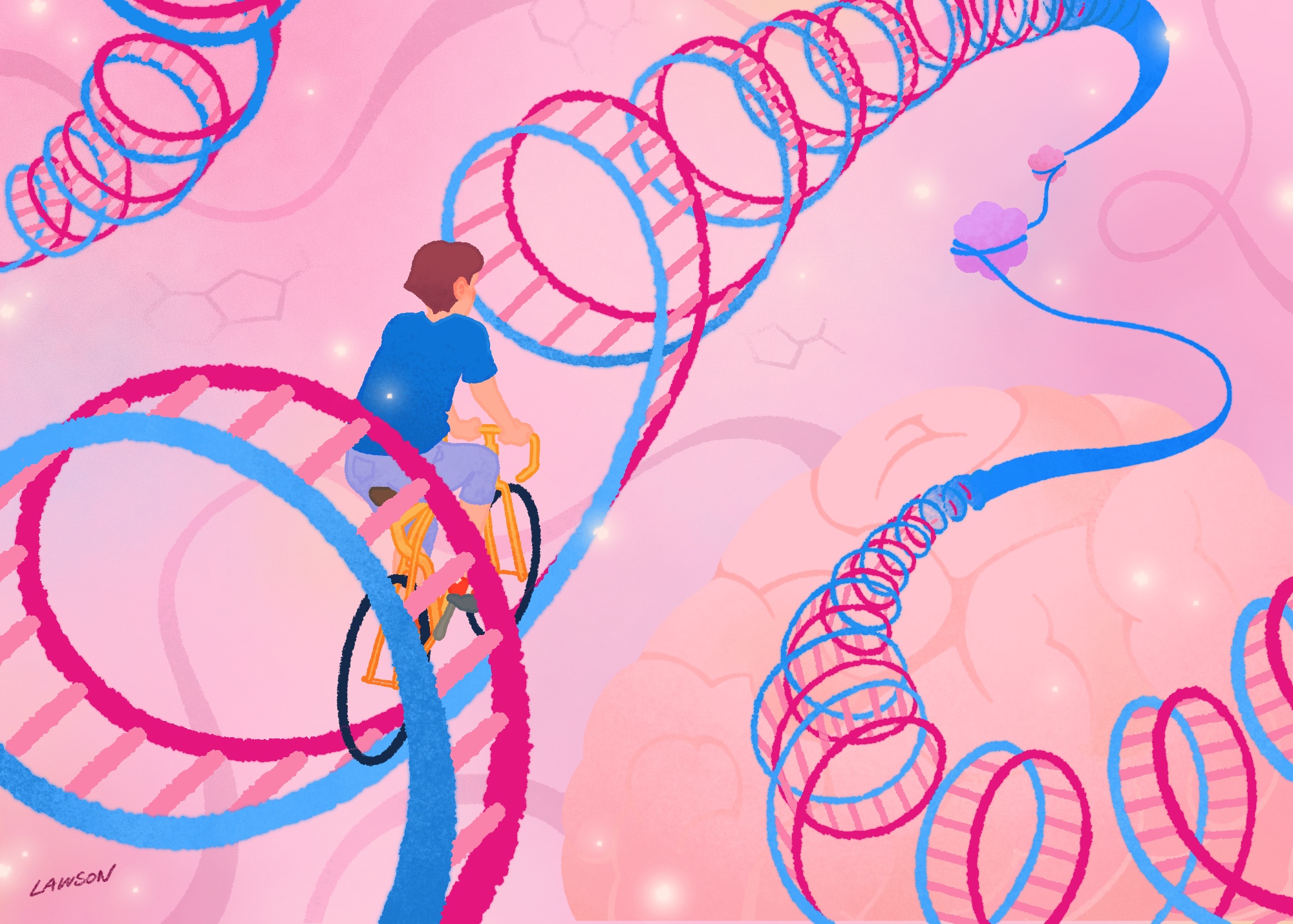
Cover Image: Liadan Lawson, February 2026
By: Becca Carballal, Contributing Writer
Finals season is fast approaching, and with it are also coming many hours spent in the library poring over a semester’s worth of notes and trying to memorize every last detail in your professor’s slide deck. Around this time of year, we are bombarded with reminders to take breaks and recharge, and almost always included among these suggestions is the advice to “get your blood moving” or “just go for a walk.” Even though it may seem trivial or unproductive, this recommendation to exercise is backed by decades worth of science.
The link between exercise and improved cognitive function is supported by studies dating back as far as 1955 [1]. Nearly 10,000 clinical trials and diagnostic studies have been conducted comparing the cognitive function of individuals following regimented exercise routines with that of those in a non-exercising control group, and systematic reviews of this data have definitively proven a positive correlation between regular exercise and improved cognitive function [2]. Even studies performed on rats have demonstrated that consistent exercise increased the animals’ ability to memorize the proper path through a maze [3]. Despite this vast body of research proving the correlation between regular exercise and improved memory and learning, which exact physiological mechanisms are behind it has remained far more mysterious.
New research shows that the key to answering this question may lie in epigenetics, the study of how our bodies and environments play a role in altering our gene expression [4].
We are born with the same six million DNA base-pair sequence in each cell that encodes everything from the instructions we needed to develop from an embryo into a child, to the ones we still use to function in our daily lives [5]. Many instructions that are needed at some points in our lives are obsolete at others, and our bodies have evolved very intentionally to only transcribe the sections of DNA that are needed at a given moment. Epigenetics seeks to understand exactly how our body selects which parts of our massive instruction manual to actually read, and scientists have shown that exercise has the power to alter this.
Our DNA does not float freely in the nuclei of our cells. Normally, a majority of the long strand is tightly wrapped around proteins called histones, which provide the molecule with structure and prevent the wound sections from being transcribed [5]. New research has shown that consistent exercise can physically alter the structure of histones through a process called acetylation, the addition of an acetyl group to the tail of a histone. This addition loosens sections of DNA that were previously inaccessible and allows new genes to be transcribed [6].
But why does exercise promote histone acetylation? The answer to that question lies in our metabolism and a small molecule called Acetyl-CoA. Exercise requires lots of energy, so when we work out, the numerous chemical processes needed to generate ATP such as glycolysis and the citric acid cycle are sped up. A key byproduct of these processes is Acetyl-CoA, which often donates its acetyl group to enzymes that attach the group to histones [7]. Thus, the faster the rate of metabolism, the higher the rate of histone acetylation, promoting transcription in previously unexpressed genes.
The next step in understanding how exercise impacts our cognitive function is determining which genes are impacted most by the exercised-driven histone acetylation process. One gene in particular that researchers have focused on is called the Brain Derived Neurotrophic Factor (BDNF) gene [8]. BDNF fits the bill perfectly when it comes to linking exercise to cognitive function. Not only has research shown that transcription of BDNF is increased by the exercise-induced mechanisms discussed above, but the protein is also strongly linked to increased memory formation, memory retention, and synaptic plasticity [8, 9]. Studies conducted in humans and rats alike have demonstrated its ability to support both the growth of new neurons and the survival of old ones [8]. These effects are found to be particularly prominent in the hippocampus, the region of the brain that deals specifically with long-term memory formation. It has even been shown that BDNF levels are significantly lower in patients with neurodegenerative conditions that alter their mental abilities, such as Alzheimer’s, Parkinson’s, and Huntington’s [8].
So, how can you best take advantage of these processes to do better on your next test? The first key is consistency. Most of the studies we explored have found this positive chain of effects to occur only in groups that have been consistently exercising for at least a week, while going for one walk or hitting one workout can certainly be beneficial, creating habits is what will have the biggest impact. The other important factor is the type of exercise you choose to do. Most of these studies have found these effects to be most pronounced in groups of people doing aerobic exercise like walking, running, or biking, as opposed to shorter bursts of more intense movement.
Following these recommendations will give you the best chance of reaping the epigenetic benefits, altering your gene expression, and ultimately improving your memory and neuronal health. It may seem too good to be true, but next time you decide to take a break from studying to get some movement in, know that you are not just strengthening your muscles or your heart, you are strengthening your mind as well.
References
- Jennifer L. Etnier, Chia-Hao Shih, Aaron T. Piepmeier. (2016). The History of Research on Chronic Physical Activity and Cognitive Performance, Exercise-Cognition Interaction, Academic Press, 29-42, https://doi.org/10.1016/B978-0-12-800778-5.00002-5
- Revelo Herrera, S. G., & Leon-Rojas, J. E. (2024). The Effect of Aerobic Exercise in Neuroplasticity, Learning, and Cognition: A Systematic Review. Cureus, 16(2), e54021. https://doi.org/10.7759/cureus.54021
- Lee, D. Y., Im, S. C., Kang, N. Y., & Kim, K. (2023). Analysis of Effect of Intensity of Aerobic Exercise on Cognitive and Motor Functions and Neurotrophic Factor Expression Patterns in an Alzheimer’s Disease Rat Model. Journal of personalized medicine, 13(11), 1622. https://doi.org/10.3390/jpm13111622
- Fernandes, J., Arida, R. M., & Gomez-Pinilla, F. (2017). Physical exercise as an epigenetic modulator of brain plasticity and cognition. Neuroscience and biobehavioral reviews, 80, 443–456. https://doi.org/10.1016/j.neubiorev.2017.06.012
- Alberts B, Johnson A, Lewis J, et al. (2002). Chromosomal DNA and Its Packaging in the Chromatin Fiber. Molecular Biology of the Cell. 4th edition. New York: Garland Science. https://www.ncbi.nlm.nih.gov/books/NBK26834/
- Li, J., Zhang, S., Li, C. et al. (2024). Endurance exercise-induced histone methylation modification involved in skeletal muscle fiber type transition and mitochondrial biogenesis. Sci Rep 14, 21154. https://doi.org/10.1038/s41598-024-72088-6
- Fernando Gomez-Pinilla, Pavan Thapak. (2024). Exercise epigenetics is fueled by cell bioenergetics: Supporting role on brain plasticity and cognition, Free Radical Biology and Medicine, 220, 43-55, https://doi.org/10.1016/j.freeradbiomed.2024.04.237
- Bathina, S., & Das, U. N. (2015). Brain-derived neurotrophic factor and its clinical implications. Archives of medical science : AMS, 11(6), 1164–1178. https://doi.org/10.5114/aoms.2015.56342
- Mizuno, M., Yamada, K., Olariu, A., Nawa, H., & Nabeshima, T. (2000). Involvement of brain-derived neurotrophic factor in spatial memory formation and maintenance in a radial arm maze test in rats. The Journal of neuroscience : the official journal of the Society for Neuroscience, 20(18), 7116–7121. https://doi.org/10.1523/JNEUROSCI.20-18-07116.2000
- Romero, S. (2020). Exercise and brain health [jpeg]. The Catalyst Newspaper, https://thecatalystnews.com/2022/01/27/exercise-and-brain-health/

 The Abstract