
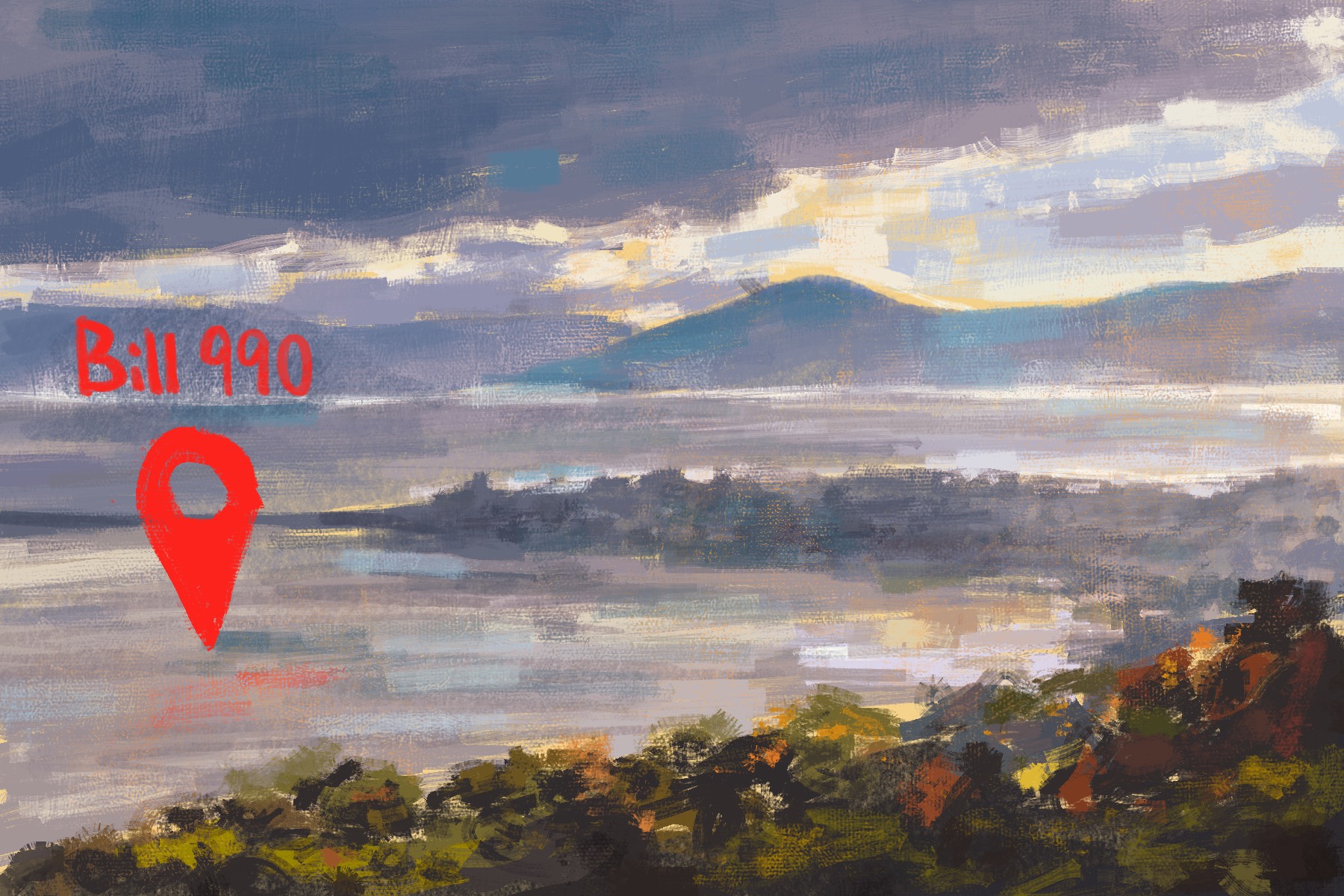
Cover image: May Wang, February 2026
By: Quinny Boyle, Contributing Writer
Stretching from Lake Ontario, past Montreal, and out to the Atlantic Ocean, the St. Lawrence River is one of the largest rivers in North America. It facilitates trade, provides hydroelectric power, and is one of the main sources of drinking water for Montreal (1). It is also home to a wide variety of organisms, including fish, seabirds, and whales. Thus, the St. Lawrence is an important natural feature, and its welfare is directly tied to that of Montreal, and Canada as a whole.
In 1988, the governments of Canada and Québec came together to create the St. Lawrence Action Plan (SLAP), designed to restore and protect the river (2). The most recent SLAP agreement was created in 2011 and will be in effect until 2026. It focuses on current issues such as invasive species control, climate change assessments, and pharmaceuticals in the river (2). Since its initiation, SLAP has made significant improvements toward protecting the health of the river. This includes granting protection to many natural habitats and reducing toxic discharge into the river (2).
One of the most important implementations of this organization is a series of reports titled “Overview of the state of the St. Lawrence,” which compiles data measuring the current health of the river (2). This overview report has been released every five years since 2003 (3). It tests a variety of factors ranging from water quality to biological resource abundance; each factor is measured on a five-level scale from “bad” to “good.” This data is then used to assess damage and provide a basis for future regulations.
The most recent report was published in 2024. Although more than a third of the factors have maintained or improved their “good” status since the 2019 report, others have not improved or are even getting worse (3). According to the 2024 report, the most severe issues currently facing the St. Lawrence are acidity, dissolved oxygen, temperature, and sea ice levels (3).
These issues are mainly a result of the changing climate. The increase of global temperatures is causing a rise in the river temperature, thus melting sea ice and lowering the solubility of dissolved oxygen. In addition, the growing levels of carbon dioxide in our atmosphere lead to increased acidity of global waters (4).
These changes have serious effects on the organisms living in the St. Lawrence. The depleting levels of oxygen, for example, reduce the lifespan of many fish species and cause a shift in the composition of benthic communities (5). Although the effects of the depleted oxygen levels and increased acidity have not directly harmed larger marine species or humans, they give way to a cascade effect. As smaller species are affected by the rapid change in water quality, their predators become sick or lose their food supply. Continuing up the food chain, humans that consume the predator species develop a risk of sickness. Thus, the deteriorating water quality directly results in biodiversity reduction and poses a health risk for all.
Although SLAP has made significant improvements in restoring the health of the St. Lawrence, there are still many other movements being created to further ensure its protection. The latest proposals represent a new era of conservation of natural resources. They focus on protecting the river by acknowledging the river’s intrinsic rights as opposed to its benefit to humans.
Bill 990, for example, was proposed to grant protection, conservation, and restoration rights to the St. Lawrence. It appointed a seven-member council to defend these rights in courts (6). The National Assembly of Québec did a first reading of Bill 990 on May 5th, 2022, but since then there has been no further progress on the bill (7).
In addition to the rights proposed in Bill 990, the Assembly of First Nations Québec-Labrador has declared that the St. Lawrence has a legal personhood (8). Lately, there has been a movement in granting legal personhood to natural features, including rivers. Legal personhood grants further rights and responsibilities to an entity. All human beings have this status, as well as some corporations. Legal personhood status for the St. Lawrence would allow lawsuits on behalf of the river for violating its right to flow freely without physical or chemical disruption. This status facilitates conservation efforts by stepping away from the traditional anthropocentric view of resources and acknowledging resources as entities in themselves. Although the resolution granting legal personhood to the St. Lawrence has not been turned into law, it is a step toward further conservation efforts.
The Assembly of First Nations Québec-Labrador is composed of the 43 chiefs of the First Nations in the Québec-Labrador area (9). Thus, this resolution demonstrates the value of this river to the First Nations communities. Bill 990 also has Indigenous representation, as two members of the council would be representatives of the eleven Indigenous nations of Québec (8, 9). These proposals are important for enforcing the role of Indigenous people in decision-making conversations surrounding the river.
There remains tension between conservation, political, and economical parties that split the intention of protecting the river between supporting the human population, supporting the organisms living within, and giving the river itself rights. Despite these tensions, all parties agree that the St. Lawrence river deserves protection.
References
- Marsh, J. (2022). St. Lawrence River. In The Canadian Encyclopedia. Retrieved from https://thecanadianencyclopedia.ca/en/article/st-lawrence-river 2. Our history. St. Lawrence Action Plan. https://www.planstlaurent.qc.ca/en/our-history
- Fast Facts 2024. (2024). St. Lawrence Action Plan. https://www.planstlaurent.qc.ca/en/developing-knowledge/overview-of-the-state-of-the-st-lawrence/translate-to-english-faits-saillants-2024
- Ocean acidification. (2025, September 25). National Oceanic and Atmospheric Administration. https://www.noaa.gov/education/resource-collections/ocean-coasts/ocean-acidification
- Marine species in St. Lawrence Estuary endangered by rapid drop in levels of oxygen. (2021, November 26). McGill Newsroom. https://www.mcgill.ca/newsroom/channels/news/marine-species-stlawrence-estuary-endangered-rapid-drop-levels-oxygen-335187
- Quebec Official Publisher. Bill 990: An Act to confer rights on the St. Lawrence River. (2022). National Assembly of Quebec. https://ecojurisprudence.org/wp-content/uploads/2024/02/22-990a-3.pdf
- Rights of Nature Law and Policy. Harmony With Nature United Nations. http://www.harmonywithnatureun.org/rightsOfNature/
- ALLIANCE FOR THE DEFENCE OF THE ST. LAWRENCE RIVER. (2023, April 19). Assembly of First Nations Quebec-Labrador. https://ecojurisprudence.org/wp-content/uploads/2023/07/04-2023-Defence-on-St-Lawrence-RIver-Declaration-APNQL.pdf
- About us. Assembly of First Nations Quebec-Labrador. https://apnql.com/en/about-us/
Image source: Dee, Riley. 22 August 2024.; Leadnow Canada. 19 September 2016. Ghislain Picard. https://www.flickr.com/photos/leadnow/2979892125/in/photostream.

 The Abstract