
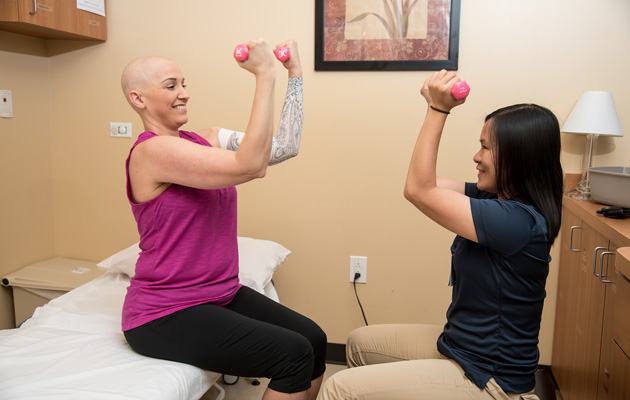
Image citation: Memorial Hermann. (n.d.). Cancer rehabilitation exercises [Photograph]. Memorial Hermann. Retrieved February 10, 2025, from https://memorialhermann.org/services/treatments/cancer-rehabilitation
By: Adam Farhart, Contributing Writer
In the relentless pursuit of a cure, we have made incredible strides in cancer diagnosis and treatment– turning what was a seemingly insurmountable challenge into a journey of resilience and hope. With these new highly sophisticated, individualized treatments extending the average life expectancy and survival rate for people with cancer, it is time for our narrative to shift from survival to the full restoration of life and well-being.
Cancer has two features that significantly hinder the ability to make a full recovery. First, it is a multifaceted disease that can take a heavy physical, emotional, and psychological toll on a person, requiring multiple medical specialists working in synchrony to provide holistic care. Second, there is no “one size fits all” treatment, so there won’t be a “one size fits all” rehabilitation plan This means that patients need to meet consistently with different specialists, which is financially prohibitive for many.
In Canada, increased breast cancer screening has allowed us to diagnose patients in the early stages and treat them as soon as possible. However, this has also created a generation of younger people with scar tissue, fibrosis, and shortening of soft tissues– creating chronic pain, reduced mobility, and other treatment related disabilities of the upper limb. And with increasingly young cancer survivors, we need more rehabilitation specialists and more education about the side effects of cancer treatments. These will get us one step closer to removing the stigma around breast cancer, lightening the physical and mental load, and promoting full reintegration into society.
Although individualized care is most efficient and often necessary, breast cancer has some common, long-term side-effects (1). This article will go over three staple components of breast cancer rehabilitation to demystify and give a general understanding of the work that can be done.
Surgery is a very common treatment for breast cancer. To prepare for surgery and minimize side effects, patients meet with a Physical Therapist for pre-operative treatment usually working on shoulder range of motion in flexion and abduction and grip strength as a form of “pre-hab” (2). After surgery, range of motion and shoulder mobility is maintained while strengthening weak muscles, stretching tight muscles, and incorporating core and posture work (3).
Axillary Web Syndrome (AWS) is the development of fibrotic bands or “cords” in the armpit region in patients who have undergone lymph node dissection in that area for breast cancer. These cords are veins that have thickened and hardened and can create swelling, pain, discomfort, and limit range of motion (4,5). AWS is self-limited, meaning it can resolve itself over time with no extensive medical treatment, but physical therapy is used to shorten duration, pain relief, and mobility improvement.
Finally, drugs that lower estrogen levels can be effective in treating cancer but can also lead to reduced bone mass or bones becoming brittle and fragile (6). Rehabilitation specialists have many ways of minimizing bone loss and maintaining strength through exercise and cardio, and protecting people by fracture education, treatment, and prevention (7).
These are examples of rehabilitation and the long-term side effects of breast cancer, but it is by no means a conclusive list. I don’t expect readers to remember how to treat Axillary Web Syndrome or osteoporosis. But, if there is one thing I want you to remember from this article, it’s that cancer is not a death sentence. Stay positive, brave through treatment and rehab, and you can come back stronger and enjoy life after cancer.
References
- Bast, R. C., & Hortobágyi, G. N. (2004). Individualized Care for Patients with Cancer — A Work in Progress. New England Journal of Medicine/the New England Journal of Medicine, 351(27), 2865–2867. https://doi.org/10.1056/nejme048300
- Yang, A., Sokolof, J., & Gulati, A. (2018). The effect of preoperative exercise on upper extremity recovery following breast cancer surgery: a systematic review. International Journal of Rehabilitation Research, 41(3), 189–196. https://doi.org/10.1097/mrr.0000000000000288
- Ibrahim, M., Muanza, T., Smirnow, N., Sateren, W. B., Fournier, B., Kavan, P., Palumbo, M., Dalfen, R., & Dalzell, M. (2018). A pilot randomized controlled trial on the effects of a progressive exercise program on the range of motion and upper extremity grip strength in young adults with breast cancer. Clinical Breast Cancer, 18(1), e55–e64. https://doi.org/10.1016/j.clbc.2017.06.007
- Fourie, W., & Robb, K. (2009). Physiotherapy management of axillary web syndrome following breast cancer treatment: Discussing the use of soft tissue techniques. Physiotherapy, 95(4), 314–320. https://doi.org/10.1016/j.physio.2009.05.001
- Dinas, K., Kalder, M., Zepiridis, L., Mavromatidis, G., & Pratilas, G. C. (2019). Axillary web syndrome: Incidence, pathogenesis, and management. Current Problems in Cancer, 43(6), 100470. https://doi.org/10.1016/j.currproblcancer.2019.02.002
- Lester, J. E., & Coleman, R. E. (2005). Bone loss and the aromatase inhibitors. British Journal of Cancer, 93(S1), S16–S23. https://doi.org/10.1038/sj.bjc.6602691
- Fontanges, É., Fontana, A., & Delmas, P. D. (2004). Osteoporosis and breast cancer. Joint Bone Spine, 71(2), 102–110. https://doi.org/10.1016/j.jbspin.2003.02.001

 The Abstract