
By: Iarina Murasan, Contributing Writer
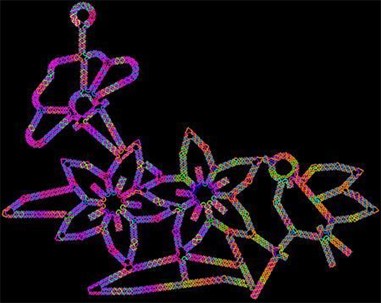
To most, origami is a traditional Japanese paper-folding technique that results in beautiful, mind-blowing little 3D sculptures. However, for scientists, this art style might be key to new advances in the field of DNA research.
While some (like myself) might argue that paper origami is hard enough, surely DNA cannot be folded as easily as a piece of paper – so how is it done? The principles behind it, which were discovered and developed by Paul Rothemund in 2006, are quite basic3. A normal DNA double helix is flexible, repeatedly twists every 3.4 to 3.6 nm, and can be brought together by hydrogen bonding coupling adenine and thymine, and cytosine and guanine5. However, when the complementarity between the strands is incomplete, an 4-branched structure called the Holliday junction can naturally appear5. From that starting point, scientists have synthetically achieved more complex branched DNA complexes, like crystals, cubes, and tubes5. The DNA strands do not automatically take on these complex shapes: longer DNA strands are Watson-Crick base-paired under the direction of shorter oligonucleotides , acting as “staples” to hold it all together2. An algorithm helps researchers figure out which sequences to build to obtain the desired structure2.
The resulting shapes are either fun, recognizable shapes, such as a smiley face2, or more useful, therapeutically applicable tools. The shapes are potent, malleable, robust, and relatively easy to make. According to its makers, these shapes can serve as an organization shelf for other molecules such as “quantum dots, carbon nanotubes, and antibodies”, allowing, for example, a specific enzymatic cascade to occur2. The origami can be thought of as a spice shelf in a kitchen–but one that can hold “hundreds to thousands of” individual spice shakers (the quantum dots, nanotubes, and antibodies)2.
Experts are still exploring DNA origami’s full therapeutic potential, specifically in the fields of molecular virus traps, drug delivery receptacles, and complex nanorobots which could be sent in conditions too hostile and to perform tasks too dangerous for the current technology in synthetic biology2. In the same vein, DNA origami can contribute to both therapeutic and diagnostic cancer strategies–which is particularly noteworthy in a field as immense as cancer treatment, where a panoply of ideas have to be considered. By adding functional groups, scientists can structurally modify DNA to act as the foundational material for nanocarriers of chemotherapeutic drugs4. DNA origami can render chemotherapy more efficient and less toxic to patients – all relevant issues currently encountered in cancer treatment4. Shawn Douglas, a researcher at the Wyss Institute for Biologically Inspired Engineering, focuses on the ability of DNA nanocarriers to be personalized in cancer treatment3. For example, DNA aptamers (single strands that bind their target by adopting a specific conformation)6 can be designed to unwind upon contact with platelet-derived growth factors, which, if used in a DNA origami pod containing a certain cancer drug, can help deliver that drug more specifically to cancerous, rather than healthy tissue3. This specificity would reduce adverse side-effects of regular chemotherapy treatments, such as hair loss.
However, these applications are not without their fair share of difficulties. Some require a large number of short DNA structures, which, without a bigger DNA scaffold (a template upon which DNA origami can be assembled), can be hard to assemble2. But these obstacles need not be a dead end to further research. For instance, while the size of the DNA scaffold was once limited to around 10,000 nucleotides, William Shih, a biochemist at Harvard Medical School, and his team overcame this issue by developing a crisscross DNA origami in which the construction of big DNA origami structures is controlled by a 1000 times smaller DNA structure2.
To conclude, DNA origami holds great potential for practical use in various fields. Given its biodegradability, programmability, stability, and ability to hold smaller functional molecules7, DNA origami has real, useful applications in pharmacology and clinical treatments, particularly in constructing drug-delivering vehicles–which is important in cases such as cancer therapy, where the drug target is hard to reach and a systematic delivery of the drug would produce adverse effects4. We hope to see many conditions and patient needs be addressed by this new, exciting form of biotechnology.
References
- Calkins, K. (2015, October 6). Cool image: DNA Origami – Biomedical Beat Blog – National Institute of General Medical Sciences. NIGMS Biomedical Beat Blog. https://biobeat.nigms.nih.gov/2015/10/cool-image-dna-origami/
- Gerhard, D., PhD. (2024, May 21). Coming into the fold: DNA origami. The Scientist Magazine®. https://www.the-scientist.com/coming-into-the-fold-dna-origami-71496
- Shawn Douglas of the Wyss Institute develops cancer-fighting nanorobots | Harvard Magazine. (2024, February 16). Harvard Magazine. https://www.harvardmagazine.com/2012/08/cancer-fighting-robots?utm_source=university&utm_medium=email&utm_campaign=Aug12Highlights
- Udomprasert A, Kangsamaksin T. DNA origami applications in cancer therapy. Cancer Sci. 2017 Aug;108(8):1535-1543. doi: 10.1111/cas.13290. Epub 2017 Jul 3. PMID: 28574639; PMCID: PMC5543475.
- What is DNA origami. https://www.biosyn.com/faq/what-is-dna-origami.aspx
- Nimjee, S. M., White, R. R., Becker, R. C., & Sullenger, B. A. (2017). Aptamers as therapeutics. The Annual Review of Pharmacology and Toxicology, 57(1), 61–79. https://doi.org/10.1146/annurev-pharmtox-010716-104558
- Li, L., Nie, S., Du, T., Zhao, J., & Chen, X. (2023). DNA origami technology for biomedical applications: Challenges and opportunities. MedComm – Biomaterials and Applications, 2(2). https://doi.org/10.1002/mba2.37

 The Abstract