By Jacob Van Oorschot, Contributing Writer
With every winter comes flu season. What does that mean? Between larger pandemic outbreaks like the 1917 Spanish flu and a few others since, we run into seasonal epidemics of the disease. Influenza is far from a steady presence in our lives throughout the year; in Canada, seasonal influenza is a phenomenon that ramps up every November, peaks in the winter, and all but disappears come summertime (1, 2). What causes this cycle, and, following the disruption of the COVID-19 pandemic, how will it be altered in future years?

Understanding Seasonal Influenza
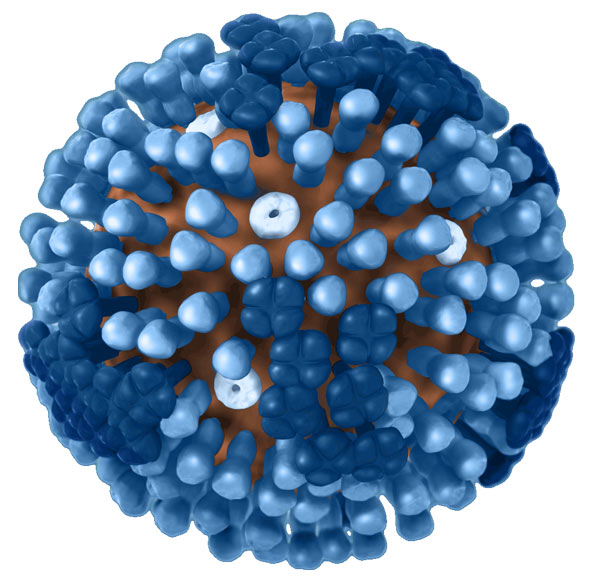
Let’s start by discussing the factors believed to have driven the cycle of seasonal influenza in the past, to understand how it could be affected in the future. Could simple changes in temperature and humidity contribute to this cycle? In an animal model (guinea pigs), dry and cold conditions are both found to lead to increased influenza transmission (3). During winter time, indoor heating causes indoor air to have a lower relative humidity than it otherwise would (3). Since warmer air holds more moisture, heating up air without adding any moisture to it results in a lower relative humidity. Individual influenza virus particles, known as virions, are most stable in low-humidity and colder conditions (3, 4, 5). When virions are more stable, they are able to persist for longer in the environment, which improves their ability to infect new hosts. One contributing mechanism for this increased stability could be that changes in the structure of the lipid envelope of virions occur based on temperature (6). Additionally, lower humidity helps the aerosols that carry influenza virions to persist for longer in the air, where they can infect us when we breathe them in (7). Finally, breathing cold winter air into our respiratory passages also reduces the intrinsic ability of their tissues to fight off infection (8). This leads us to another idea: that seasonality-based conditions may not be directly affecting influenza virions, but rather reducing our bodies’ ability to prevent infection.
We’re well familiar with reduced daylight hours in the winter. It turns out our immune systems recognize this change as well. The prevalence of different cells circulating our immune system, as well as the gene expression within them varies with the season (9, 10). For instance, BMAL1, a transcription factor that has been shown to suppress influenza replication (10, 11), is expressed less during the winter months (10, 12). This difference could partially account for why we may respond differently to influenza as the seasons change throughout the year.
Melatonin is another molecule in our body whose levels vary with the season and could contribute to changes in our susceptibility to influenza (9, 13). Our bodies produce melatonin when it is dark, so we produce more of it in the winter when the days are shorter (9). Melatonin has been shown to modulate the immune response against influenza and is being explored as a possible treatment for severe flu cases due to its ability to reduce harmful inflammation (14, 15). So shouldn’t increased melatonin in the winter protect us against the flu? Perhaps another mechanism is at play. Melatonin could increase a host’s tolerance for influenza without ultimately decreasing replication of influenza in their body. Much of the damage to our body in many infections (16), including flu cases (17), comes from our body’s immune response against the pathogen, not just the pathogen itself. Sometimes, turning down the body’s immune response can improve individual patient outcomes without actually clearing an infection (16, 18). This lack of clearance could allow greater spread of a pathogen (18, 19, 20). In conclusion, melatonin could increase tolerance to influenza, which, counterintuitively, leads to its increased spread.
Aside from melatonin, day length could also modulate host immune function by changing the body’s vitamin D levels (21, 22). Vitamin D plays a role in controlling inflammation and impacts immune cell differentiation and function. However, much of the research on these effects is carried out in cell lines and animal models, so it’s hard to know how relevant these findings are to humans (23).
Some researchers have suggested seasonal fluctuations in nutrient intake based on food availability might (22) contribute to influenza’s seasonality. Studies (24, 25) have found that intake of certain nutrients could affect influenza outcomes. However, it remains an open question whether the seasonal changes in diet that affect the intake of these nutrients actually occur (22) and, if they do, which populations are the most vulnerable to these changes. Whether seasonality-based changes in our eating behaviours could contribute to influenza seasonality remains unclear.
What about other ways our behaviour changes during the winter? Physical activity is one behaviour that generally changes seasonally, as people tend to exercise less in the winter (26). Exercise leads to transient increases in immune cell counts (27) and helps these cells circulate properly throughout the body (27). Exercise has also been seen to potentially reduce harmful inflammation (27, 28). These general immunological observations are backed up by studies showing that consistent moderate exercise is protective against severe influenza infection (29, 30, 31); so, decreased exercise during the colder months may contribute to influenza seasonality. Furthermore, decreased physical activity in the wintertime comes hand-in-hand with more time spent indoors (22), an environment that, as we have learned during the Covid-19 pandemic, favours the spread of respiratory diseases–including influenza (32, 33).
Mathematical models are a key tool in understanding disease spread, and they provide insight into one last possible driver of influenza seasonality. In effect, influenza could be seasonal because of the way it interacts with our immune system. Indeed, influenza is different from many other diseases in that it leaves us with immunity that wanes rather than sticking around for a lifetime. When this loss of immunity is included in mathematical models of epidemiology, it yields an oscillating pattern of infection that, under certain parameters, has a period of one year (34). Dushoff and colleagues observed that this oscillation, together with other factors like those mentioned above, could drive the huge swings we see in seasonal influenza (34). So far, we have discussed a number of factors that have been proposed to explain the seasonal nature of influenza epidemics–historically speaking. Did anything change upon the arrival of SARS-CoV-2, the pathogen that causes COVID-19?
Influenza in a Post-Covid World
Measures to prevent the spread of Covid-19 beginning in late 2019 massively changed seasonal influenza. For what may be the first time in recorded history, there was simply no flu season in the 2020-2021 winter in the northern hemisphere (35). When new flu strains come into the mix, they tend to push out old ones due a process known as viral interference, where infection with one virus temporarily prevents the host from being infected by another (36). While social distancing certainly reduced flu numbers, viral interference by SARS-CoV-2 against influenza strains could have compounded this effect (37).
Did the perturbations to epidemic influenza caused by COVID-19, as well as our response to it, teach us anything about the factors responsible for its seasonality? It might be too early to tell. It was only in the spring of 2023 that the World Health Organization (WHO) ended the Covid-19 pandemic’s status as a global emergency (38), making the past 2023-2024 winter the first post-Covid flu season. Our understanding of the effects of the COVID-19 pandemic on the seasonal cycle of influenza cases will be based on how influenza rebounds this winter and in coming years.
What will the future of influenza infection in human populations look like? The sudden shift in the environment with which influenza had to contend and subsequent drop in flu cases created an evolutionary bottleneck, resulting in some strains of flu simply disappearing (39). Any existing laboratory stock of these strains should be treated with great caution (39), as the re-introduction of missing influenza strains to human populations has historically caused pandemics (40). This is because immunity to influenza wanes over time, causing a population previously exposed to a given strain to become immunologically “naïve” to it over time. As a result, we are very susceptible to a given influenza strain if it returns following a long disappearance. A final consequence of waning immunity to influenza could be a reduction in antigenic drift (minor changes in the virus from mutations (41)), as influenza strains will face less immune pressure from our immune systems, driving fewer adaptations (37).
Both influenza and Covid-19 are here to stay. Fighting these two life-threatening infections will primarily come down to proven public health measures like vaccination, hygiene, and mask-wearing. But we should also pay attention to how the interaction of these two viruses can teach us about the mechanisms that allow them to individually spread. We must often settle for epidemiological studies based on natural experiments or computer simulations to reach conclusions about how respiratory diseases spread and, by extension, what measures we can take to mitigate their impact. Evolutionary biology spent a long time on the fringe between observational and experimental science, but the development of good model systems has advanced the field considerably by improving our power to make predictions and directly test hypotheses (42). Making similar advances in epidemiology would help us respond better to both recurring epidemic diseases like influenza, as well as future emerging pandemics.
References
- Schanzer DL, Langley JM, Dummer T, Viboud C, Tam TWS. 2010. A composite epidemic curve for seasonal influenza in Canada with an international comparison. Influenza and Other Respiratory Viruses 4:295–306.
- Hope-Simpson RE. 1981. The role of season in the epidemiology of influenza. Epidemiology & Infection 86:35–47.
- Lowen AC, Steel J. 2014. Roles of Humidity and Temperature in Shaping Influenza Seasonality. Journal of Virology 88:7692–7695.
- Schaffer FL, Soergel ME, Straube DC. 1976. Survival of airborne influenza virus: effects of propagating host, relative humidity, and composition of spray fluids. Arch Virol 51:263–273.
- Yang W, Elankumaran S, Marr LC. 2012. Relationship between humidity and influenza A viability in droplets and implications for influenza’s seasonality. PLoS One 7:e46789.
- Polozov IV, Bezrukov L, Gawrisch K, Zimmerberg J. 2008. Progressive ordering with decreasing temperature of the phospholipids of influenza virus. Nat Chem Biol 4:248–255.
- Yang W, Marr LC. 2011. Dynamics of Airborne Influenza A Viruses Indoors and Dependence on Humidity. PLOS ONE 6:e21481.
- Eccles R. 2002. An explanation for the seasonality of acute upper respiratory tract viral infections. Acta Otolaryngol 122:183–191.
- Dowell SF. 2001. Seasonal variation in host susceptibility and cycles of certain infectious diseases. Emerg Infect Dis 7:369–374.
- Scheiermann C, Gibbs J, Ince L, Loudon A. 2018. Clocking in to immunity. 7. Nat Rev Immunol 18:423–437.
- Edgar RS, Stangherlin A, Nagy AD, Nicoll MP, Efstathiou S, O’Neill JS, Reddy AB. 2016. Cell autonomous regulation of herpes and influenza virus infection by the circadian clock. Proc Natl Acad Sci U S A 113:10085–10090.
- Dopico XC, Evangelou M, Ferreira RC, Guo H, Pekalski ML, Smyth DJ, Cooper N, Burren OS, Fulford AJ, Hennig BJ, Prentice AM, Ziegler A-G, Bonifacio E, Wallace C, Todd JA. 2015. Widespread seasonal gene expression reveals annual differences in human immunity and physiology. Nat Commun 6:7000.
- Silvestri M, Rossi GA. 2013. Melatonin: its possible role in the management of viral infections-a brief review. Ital J Pediatr 39:61.
- Hang S-H, Liao C-L, Chen S-J, Shi L-G, Lin L, Chen Y-W, Cheng C-P, Sytwu H-K, Shang S-T, Lin G-J. 2019. Melatonin possesses an anti-influenza potential through its immune modulatory effect. Journal of Functional Foods 58:189–198.
- Xu M-M, Kang J-Y, Ji S, Wei Y-Y, Wei S-L, Ye J-J, Wang Y-G, Shen J-L, Wu H-M, Fei G-H. 2022. Melatonin Suppresses Macrophage M1 Polarization and ROS-Mediated Pyroptosis via Activating ApoE/LDLR Pathway in Influenza A-Induced Acute Lung Injury. Oxidative Medicine and Cellular Longevity 2022:1–32.
- Medzhitov R, Schneider DS, Soares MP. 2012. Disease Tolerance as a Defense Strategy. Science 335:936–941.
- Gu Y, Zuo X, Zhang S, Ouyang Z, Jiang S, Wang F, Wang G. 2021. The Mechanism behind Influenza Virus Cytokine Storm. 7. Viruses 13:1362.
- Sperry MM, Novak R, Keshari V, Dinis ALM, Cartwright MJ, Camacho DM, Paré J-F, Super M, Levin M, Ingber DE. 2022. Enhancers of Host Immune Tolerance to Bacterial Infection Discovered Using Linked Computational and Experimental Approaches. Advanced Science 9:2200222.
- Gopinath S, Lichtman JS, Bouley DM, Elias JE, Monack DM. 2014. Role of disease-associated tolerance in infectious superspreaders. Proc Natl Acad Sci U S A 111:15780–15785.
- Råberg L, Graham AL, Read AF. 2009. Decomposing health: tolerance and resistance to parasites in animals. Philos Trans R Soc Lond B Biol Sci 364:37–49.
- Sassi F, Tamone C, D’Amelio P. 2018. Vitamin D: Nutrient, Hormone, and Immunomodulator. 11. Nutrients 10:1656.
- Lofgren E, Fefferman NH, Naumov YN, Gorski J, Naumova EN. 2007. Influenza Seasonality: Underlying Causes and Modeling Theories. Journal of Virology 81:5429–5436.
- Sundaram ME, Coleman LA. 2012. Vitamin D and Influenza. Advances in Nutrition 3:517–525.
- Han SN, Meydani M, Wu D, Bender BS, Smith DE, Viña J, Cao G, Prior RL, Meydani SN. 2000. Effect of Long-term Dietary Antioxidant Supplementation on Influenza Virus Infection. The Journals of Gerontology: Series A 55:B496–B503.
- Nelson HK, Shi Q, Van Dael P, Schiffrin EJ, Blum S, Barclay D, Levander OA, Beck MA. 2001. Host nutritional selenium status as a driving force for influenza virus mutations. FASEB J 15:1727–1738.
- Shephard RJ, Aoyagi Y. 2009. Seasonal variations in physical activity and implications for human health. Eur J Appl Physiol 107:251–271.
- Simpson RJ, Kunz H, Agha N, Graff R. 2015. Chapter Fifteen – Exercise and the Regulation of Immune Functions, p. 355–380. In Bouchard, C (ed.), Progress in Molecular Biology and Translational Science. Academic Press.
- Gleeson M, Bishop NC, Stensel DJ, Lindley MR, Mastana SS, Nimmo MA. 2011. The anti-inflammatory effects of exercise: mechanisms and implications for the prevention and treatment of disease. Nat Rev Immunol 11:607–615.
- Song Y, Ren F, Sun D, Wang M, Baker JS, István B, Gu Y. 2020. Benefits of Exercise on Influenza or Pneumonia in Older Adults: A Systematic Review. 8. International Journal of Environmental Research and Public Health 17:2655.
- Kohut ML, Sim Y-J, Yu S, Yoon KJ, Loiacono CM. 2009. Chronic Exercise Reduces Illness Severity, Decreases Viral Load, and Results in Greater Anti-Inflammatory Effects than Acute Exercise during Influenza Infection. The Journal of Infectious Diseases 200:1434–1442.
- Wong C-M, Lai H-K, Ou C-Q, Ho S-Y, Chan K-P, Thach T-Q, Yang L, Chau Y-K, Lam T-H, Hedley AJ, Peiris JSM. 2008. Is Exercise Protective Against Influenza-Associated Mortality? PLOS ONE 3:e2108.
- Wei J, Li Y. 2016. Airborne spread of infectious agents in the indoor environment. American Journal of Infection Control 44:S102–S108.
- Morawska L, Allen J, Bahnfleth W, Bluyssen PM, Boerstra A, Buonanno G, Cao J, Dancer SJ, Floto A, Franchimon F, Greenhalgh T, Haworth C, Hogeling J, Isaxon C, Jimenez JL, Kurnitski J, Li Y, Loomans M, Marks G, Marr LC, Mazzarella L, Melikov AK, Miller S, Milton DK, Nazaroff W, Nielsen PV, Noakes C, Peccia J, Prather K, Querol X, Sekhar C, Seppänen O, Tanabe S, Tang JW, Tellier R, Tham KW, Wargocki P, Wierzbicka A, Yao M. 2021. A paradigm shift to combat indoor respiratory infection. Science 372:689–691.
- Dushoff J, Plotkin JB, Levin SA, Earn DJD. 2004. Dynamical resonance can account for seasonality of influenza epidemics. Proc Natl Acad Sci U S A 101:16915–16916.
- Lee SS, Viboud C, Petersen E. 2022. Understanding the rebound of influenza in the post COVID-19 pandemic period holds important clues for epidemiology and control. Int J Infect Dis 122:1002–1004.
- Laurie KL, Guarnaccia TA, Carolan LA, Yan AWC, Aban M, Petrie S, Cao P, Heffernan JM, McVernon J, Mosse J, Kelso A, McCaw JM, Barr IG. 2015. Interval Between Infections and Viral Hierarchy Are Determinants of Viral Interference Following Influenza Virus Infection in a Ferret Model. J Infect Dis 212:1701–1710.
- Laurie KL, Rockman S. 2021. Which influenza viruses will emerge following the SARS-CoV-2 pandemic? Influenza and Other Respiratory Viruses 15:573–576.
- Press · TA. 2023. WHO downgrades COVID pandemic, says it’s no longer a global emergency | CBC News. CBC. https://www.cbc.ca/news/health/who-pandemic-not-emergency-1.6833321. Retrieved 29 October 2023.
- Dhanasekaran V, Sullivan S, Edwards KM, Xie R, Khvorov A, Valkenburg SA, Cowling BJ, Barr IG. 2022. Human seasonal influenza under COVID-19 and the potential consequences of influenza lineage elimination. 1. Nat Commun 13:1721.
- Rozo M, Gronvall GK. 2015. The Reemergent 1977 H1N1 Strain and the Gain-of-Function Debate. mBio 6:e01013-15.
- CDC. 2022. How Flu Viruses Can Change. Centers for Disease Control and Prevention. https://www.cdc.gov/flu/about/viruses/change.htm. Retrieved 16 February 2024.
- Kassen R. 2014. Experimental Evolution and the Nature of Biodiversity. Roberts and Company Publishers.
Image sources: Maria Patzen/ iStock; https://www.istockphoto.com/photo/crossroad-the-symbol-is-to-make-a-choice-gm1155166192-314385779, U.S. Center for Disease Control, Virus Images; https://www.cdc.gov/flu-resources/media/files/2024/07/3d-influenza-blue-full-600px.jpg

 The Abstract