
A theory to explain how we are conscious which is so bizarre, it just might be true.
By Ronit Mohapatra
On March 14, 2023, a major milestone was reached in the world of computing: OpenAI researchers released the large language model GPT-4 which powers ChatGPT. For the first time, there was scientific consensus that we had developed a program which would pass the Turing Test [1]. This “test” is more of a thought experiment which posits that if a human judge cannot distinguish between conversation with a machine and conversation with another human, that machine would be capable of human-level thought and intelligence, perhaps even consciousness. So then, is ChatGPT conscious? Clearly not.
Consciousness is not just the ability to hold a normal conversation, which language models are optimized for; it is the ability to perceive reality through subjective perception and sensation [2]. The origin of biological consciousness is one of the most fundamental questions posed by humanity. In short, we do not know. Despite this daunting mystery, through cutting edge psychological and neurological studies we have recently developed concrete theories for how a clump of neural tissue in our skulls results in self-awareness. This article explores one particular theory known as Orchestrated Objective Reduction (Orch-OR) proposed in 1996 by Nobel Laureate Sir Roger Penrose along with Dr. Stuart Hameroff, an anesthesiologist, which hypothesized that consciousness originates on the quantum level within neurons.
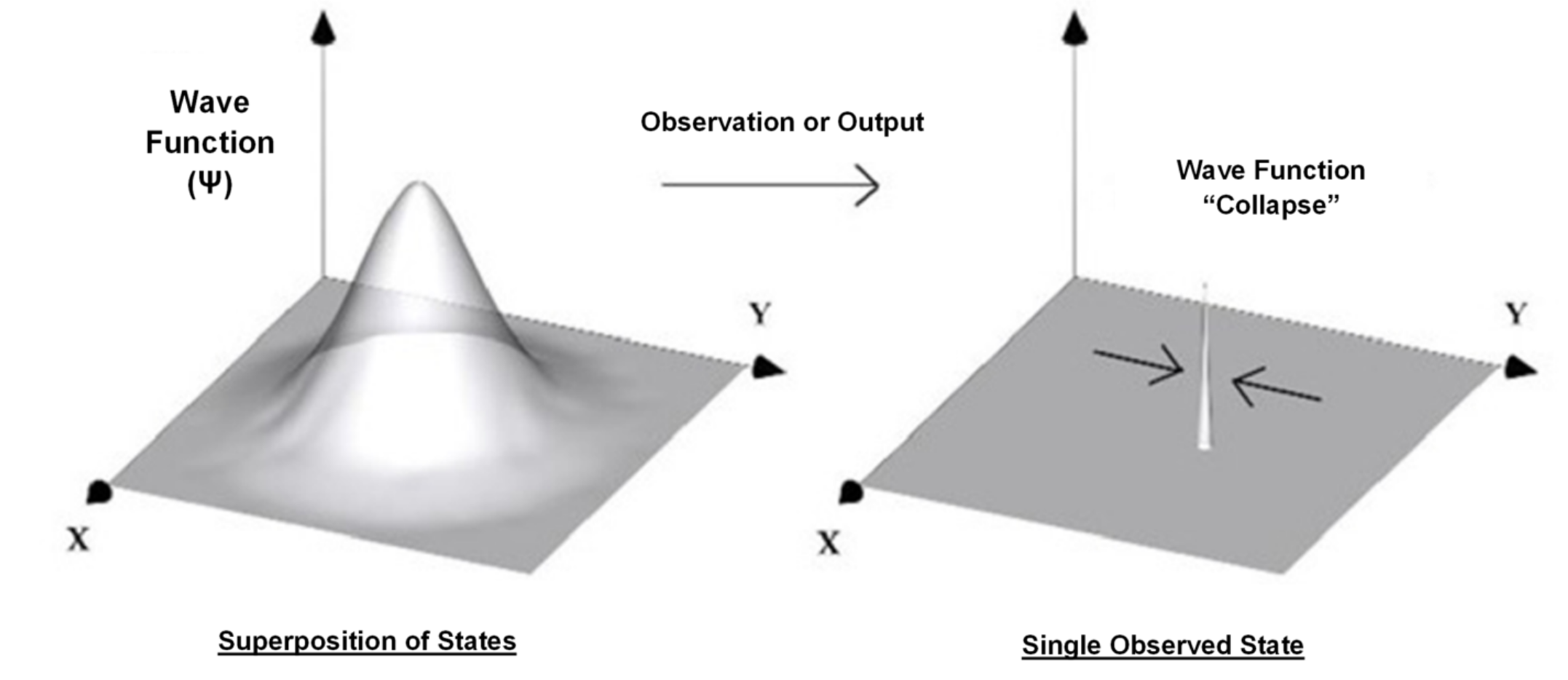
To understand Orch-OR, we need to first familiarize ourselves with two fundamental concepts of quantum physics: “superposition” and “wavefunction collapse”. Unlike classical physics, quantum theory states we do not live in a deterministic universe. This means, on a very small scale, even if one knew all of the possible information about a quantum particle, they could not predict its future state with absolute certainty. Instead, quantum systems are based on probability. If you have a particle in a box, there is a chance of the particle being found anywhere within the box, though the chance is higher in certain areas. The probability distribution of the particle can be visualized as a wave: higher in some spots and lower in others, which can be represented mathematically as a wavefunction [3]. Since the wavefunction represents the probability of different states and not any one state alone, we can say quantum systems exist in a superposition of states; in effect, they are essentially in multiple states at once [3]. Finally, the key point is that when it comes time for an isolated quantum system to be observed or to emit some measurable “output”, the wavefunction collapses down into a single state [3, 4]. (see Figure 1 for an illustration of these concepts)
The idea of superposition followed by wavefunction collapse underlines Orch OR theory. All brain activity, including sensation and thought generation, is relayed through the movement of electrical charges between neurons. Neural signals exist as electric impulses which travel through a neuron and then jump a gap (a synapse) to another [2]. Penrose and Hameroff theorize the existence of a superposition of states prior to the generation of each neural signal (each “conscious moment”). The wavefunction corresponding to this setup then collapses (Penrose refers to this as reduction) to influence the chemical and electrical nature of neural signals. This collapse is triggered by the neurons reaching some objective threshold of inputs which come in the form of sensory signals or electric impulses from other neurons [5, 6].
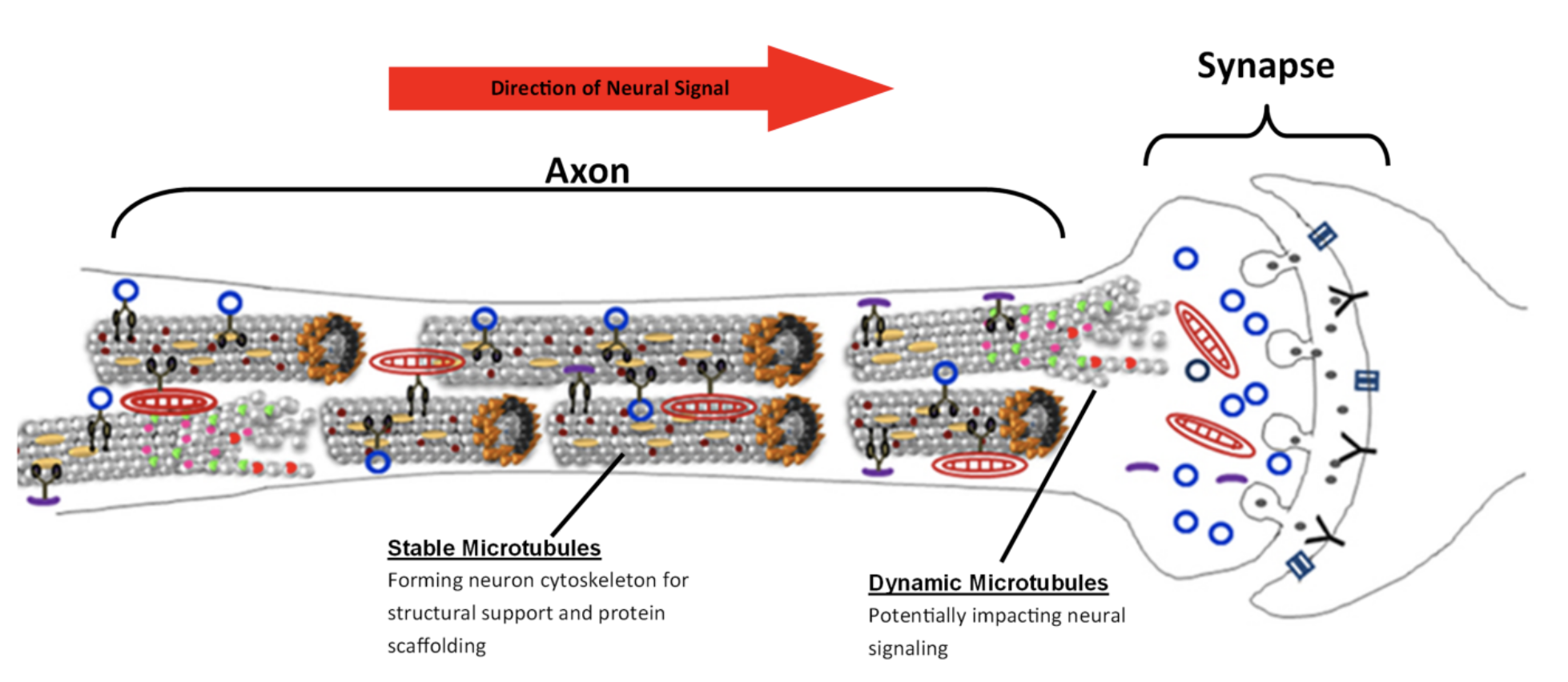
Biophysically, this mechanism relies on microtubules, which are intracellular fibers composed of tubulin proteins. Microtubules maintain cell structure and provide internal organization by forming several interconnected networks [7, 8]. In the termini of neurons, dynamic microtubule structures contain tubulin subunits which change conformation to influence the electrochemical properties of neurons and thus influence signaling within the brain (see Figure 2). If a given microtubule subunit exists in a superposition, this will modify the local electronic environment, and surrounding components of the cytoskeletal network may become “entangled”, such that the collapse of their wavefunctions and positioning into specific conformations is synchronized [6]. This phenomenon is known as orchestration. In this way, the neuronal microtubule network could theoretically change conformation as a whole and seamlessly modify neural signal outputs [9].
To summarize orchestrated objective reduction: networks of microtubules host synchronized superpositions within neurons. These networks eventually reach some objective threshold due to sensory inputs and previous electrochemical signaling which triggers the collapse of the superposition or reduction to a single state. This then results in modifications to neural signaling and the production of a conscious moment. Crucially, each conscious moment lasts for only a minuscule fraction of a second, so they must occur sequentially and at a high frequency, like frames in a video. The sum of all of these moments creates what we perceive as a continuous conscious experience [6]. As this theory relies on a quantum mechanism, the exact prediction of any given collapse is definitively unknowable. It is entirely dependent on probability. In other words, the mechanism by which consciousness is generated is not deterministic which provides a potential explanation of free will, since our current and future reality cannot be totally determined by past events [10].
Before we get carried away, I must emphasize once again that Orch OR firmly remains in the realm of hypothesis. There is some suggestive evidence for this theory such as observations that anesthetic treatment, which temporarily removes consciousness, directly modulates microtubule stability. Specifically, neuronal tubulin acts as a binding site for general anaesthetic molecules. This interaction is essential to maintain the anaesthetic effect, potentially by inhibiting the polymerization of dynamic microtubules [11].
There has equally been harsh critique of the theory from both physicists and neurobiologists such as McKemmish et al., who berated the lack of biological evidence that tubulin molecules could oscillate conformation rapidly enough for what would be required by Orch OR theory [12]. We currently lack the analytical technology to detect or demonstrate quantum interference between microtubules, as these are extremely subtle events occurring on microscales. Given that Orch OR hinges entirely on the existence of these quantum interferences, Hameroff himself recently remarked of it to be “the most complete, and most easily falsifiable theory of consciousness” as compared to other theories based in classical mechanics [13].
Even today in our world of language models and open access AIs, the question of consciousness remains open. As biophysical techniques advance, we are only getting closer to uncovering its underlying mechanism and showing definitively whether or not there are true biological lessons to be taken from Orch OR and quantum mechanics.
References
- Dodig-Crnkovic, G. How GPT Realizes Leibniz’s Dream and Passes the Turing Test without Being Conscious. in Computer Sciences & Mathematics Forum. 2023. MDPI. https://doi.org/10.3390/cmsf2023008066
- Koch, C., What is consciousness. Nature, 2018. 557(7704): p. S8-S12. What Is Consciousness? (nature.com)
- Bassi, A., et al., Models of wave-function collapse, underlying theories, and experimental tests. Reviews of Modern Physics, 2013. 85(2): p. 471. https://doi.org/10.48550/arXiv.1204.4325
- Leong, D., Probabilistic Interpretation of Observer Effect on Entrepreneurial Opportunity. Organizacija, 2022. 55(4): p. 243-258. https://doi.org/10.2478/orga-2022-0016
- Hameroff, S. and R. Penrose, Orchestrated reduction of quantum coherence in brain microtubules: A model for consciousness. Mathematics and computers in simulation, 1996. 40(3-4): p. 453-480. https://doi.org/10.1016/0378-4754(96)80476-9
- Collins, A.L., Orchestrated objective reduction: quantum physics and its implications in human consciousness. College of William and Mary—Degree Program thesis, 2015. Collins_Amanda.pdf (wm.edu)
- Rolls, M.M., P. Thyagarajan, and C. Feng, Microtubule dynamics in healthy and injured neurons. Developmental neurobiology, 2021. 81(3): p. 321-332.
- Dent, E.W., Dynamic microtubules at the synapse. Current opinion in neurobiology, 2020. 63: p. 9-14. https://doi.org/10.1002%2Fdneu.22746
- Hameroff, S., Quantum walks in brain microtubules—A biomolecular basis for quantum cognition? Topics in cognitive science, 2014. 6(1): p. 91-97. https://doi.org/10.1111/tops.12068
- Ahmadpour, S., Synaptic microenvironment and altered state of consciousness in schizophrenia: a possible link between synapse geometry and orchestrated objective reduction theory. The Egyptian Journal of Neurology, Psychiatry and Neurosurgery, 2023. 59(1): p. 117. https://doi.org/10.1186/s41983-023-00719-2
- Emerson, D.J., et al., Direct modulation of microtubule stability contributes to anthracene general anesthesia. Journal of the American Chemical Society, 2013. 135(14): p. 5389-5398. https://doi.org/10.1021/ja311171u
- McKemmish, L.K., et al., Penrose-Hameroff orchestrated objective-reduction proposal for human consciousness is not biologically feasible. Physical Review E, 2009. 80(2): p. 021912. https://doi.org/10.1103/physreve.80.021912
- Hameroff, S., ‘Orch OR’is the most complete, and most easily falsifiable theory of consciousness. Cognitive Neuroscience, 2021. 12(2): p. 74-76. https://doi.org/10.1080/17588928.2020.1839037
- Dubey, J., N. Ratnakaran, and S.P. Koushika, Neurodegeneration and microtubule dynamics: death by a thousand cuts. Frontiers in cellular neuroscience, 2015. 9: p. 343. https://doi.org/10.3389/fncel.2015.00343
Image source: Quantum Randomness: Unlocking the Secrets of Consciousness | by Gustav Stieger | Medium

 The Abstract