
By Sacha Mitchell, Contributing Writer
In 2019, the World Health Organization (WHO) named vaccine hesitancy as a top 10 threat to global health [1]. The measles, mumps and rubella (MMR) vaccine protects children against three serious contagious illnesses and has been used worldwide since the 1970s. Yet, MMR vaccination rates in high-income countries have fluctuated and are currently dropping [2-4]. Why are vaccination rates declining, and more importantly, what are the public and global health consequences?
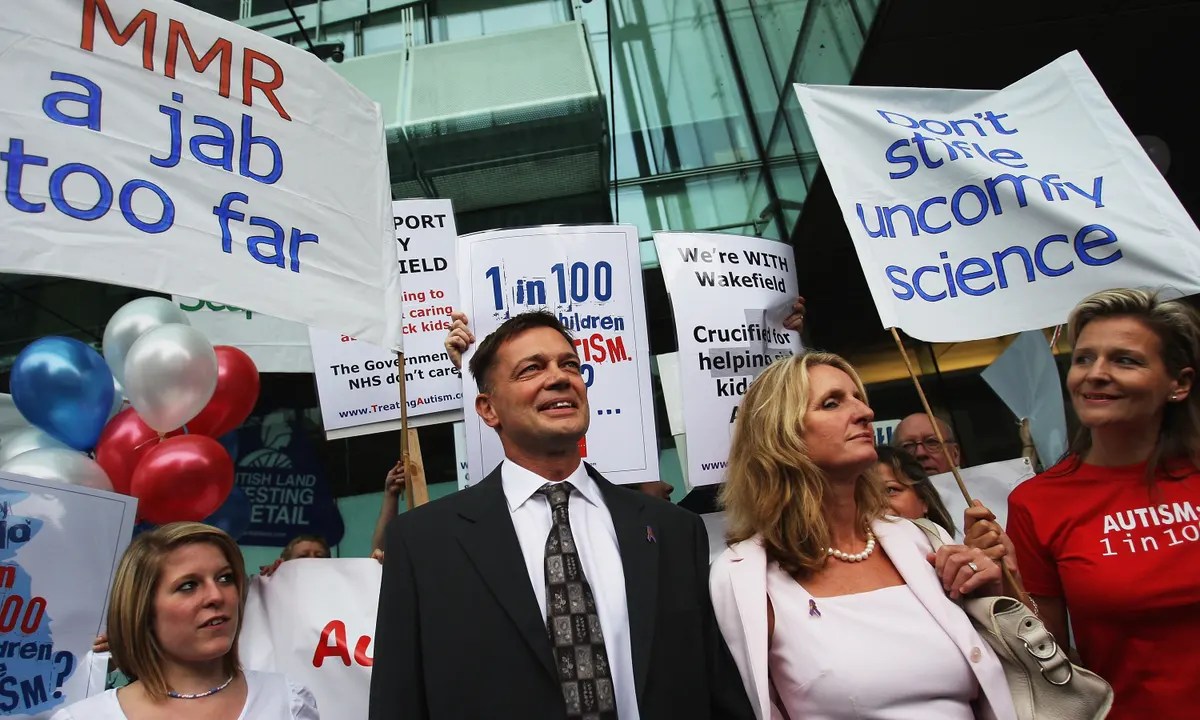
Vaccine hesitancy, defined as the delay or refusal to take vaccines despite their availability, dates to the 18th century with the invention of immunization by Edward Jenner [5]. However, in the case of the MMR vaccine, this can be traced back to the 1990s when a British gastroenterologist fraudulently claimed that the MMR vaccine caused autism in children. The controversial (“controversial” is an understatement) paper in The Lancet was thankfully retracted about a decade later, but its effects were tragic and are still felt to this day [6].
Let us look at some numbers to put this movement into perspective: measles outbreaks have appeared just about everywhere in the Global North since the early 2000s, despite the virus’ elimination in some of those countries [7]. Between 1996 and 2004, MMR vaccination rates in Wales and England dropped from 91.8% to 79.9% (and as low as 60% in some regions). In 2006, the incidence of measles was 37 times higher than a decade earlier in those same nations. That same year, measles was declared endemic (regularly occurring) in the UK for the first time since the mid-90s [8]. It was later revealed that Andrew Wakefield, the physician responsible for the MMR vaccine fraud, was paid a large sum by anti-vaccine lobbyists to publish research that agreed with their views [9]. This dramatic conflict of interest was, of course, undisclosed in the original paper.
It must be made clear that there is not a shred of evidence showing causation between the MMR vaccine and autism. The MMR vaccine fraud is the epitome of failure in science: it delegitimizes research, the peer review process, and destroys the public’s trust in our scientific institutions. As scientists, we need to be able to point to the research process as something reliable and trustworthy, but articles like Wakefield’s slipping through the cracks of one of the most respected medical journals make this increasingly difficult. This type of misstep becomes incredibly powerful ammunition for the far-right, anti-science politicians who constitute a direct threat to global and public health.
The MMR vaccine’s main purpose is to prevent the spread of measles, an extremely contagious and deadly viral infection. Measles is one of the most infectious diseases known to humans, far more contagious than SARS-CoV-2 (the virus causing COVID-19) or the common influenza virus. Before vaccination was widely rolled out in the 70s, 90% of children contracted measles before reaching age 15, and millions died [10]. In fact, before the advent of the vaccine, measles was a leading cause of childhood death worldwide [11]. The MMR vaccine is a marvel of modern medicine; it is estimated to have prevented 20.4 million deaths between 2000 and 2016 [12]. We should be celebrating this achievement! Instead, it is being used as a fear mongering political weapon against parents, while putting the lives of children at risk.
The vaccine works by delivering a weakened portion of the virus to the host, stimulating the body’s immune system to develop a long-lasting memory cell to fight off future exposures [13]. Simply put, it is like going to the gym for the immune system! It might be a little uncomfortable for some, but it undoubtedly strengthens immunity. I would be remiss if I did not take this opportunity to dispel a common vaccination myth: the MMR vaccine does not give children measles. The viral components delivered are greatly attenuated, and therefore very safe. Although side effects do exist (as they do for all drugs), they are extremely rare and acknowledged by physicians. The weakened virus is, however, foreign to your body, which is why the immune system reacts to it. The MMR vaccine is given to children in two doses, between the ages of 9 months and 6 years. Indeed,
Children start showing signs of autism spectrum disorder within this age range, and often even before turning 9 months old…[13] you can now infer the implications of this false correlation at hand.
Effectiveness rates in preventing measles are over 99% for people who received two doses. Furthermore, those who end up getting infected after receiving two doses are far less likely to become seriously ill [13]. So, if we can vaccinate and effectively protect our children against a deadly virus, why do dropping vaccination rates at the population level matter?
To understand the effects of MMR vaccine hesitancy, we must first look at the goals of vaccination. Herd immunity is the concept of a collective immunity that is reached by minimizing transmissions of disease, in turn assuring individual protection due to a favourable ratio. By vaccinating a population, the general public – including those unable to be vaccinated – is protected from disease transmission. However, for herd immunity to be effective, a very high percentage of the population must get vaccinated. In the case of the MMR vaccine, this target percentage is between 93% and 95% [14]. This number is so high because, as mentioned previously, measles is one of the most contagious pathogens we know of. In fact, its R0 value, or the average number of people an infected individual passes the virus to, is estimated to be between 12 and 18! [15] For reference, the R0 for the Omicron SARS-CoV-2 variant is about 3.4 [16]. If vaccination rates drop below this 93–95% range, probabilities of an outbreak increase, which is detrimental and possibly fatal for people who are not vaccinated (either by choice or not) and, in rare cases, for those who are. At first glance, nation-wide rates in the United States and Canada are encouraging and close to these target values. The problem is that hesitancy and refusal to vaccinate tend to cluster in geographic regions. Outbreaks are far more likely to occur in these under-vaccinated regions and result in preventable serious illnesses and/or deaths (see 2015 Disneyland, 2019 New York, 2019 Pacific Northwest measles outbreaks) [17]. Fortunately, these are localized events that seldom result in deaths. However, with the decrease in vaccination rates in the last two decades (which was greatly exacerbated by the COVID-19 pandemic), a global measles outbreak is conceivable [18]. Considering we have had an effective measles vaccine for over 50 years, this idea is worrisome. The capabilities of science are extraordinary: we are able to edit genomes on a laboratory benchtop, create large language models powered by artificial intelligence, and more! Yet, public health research is politicized and demonized to the point that a significant portion of the population rejects well-established work that has been around for decades.
Getting your children vaccinated is a social responsibility as much as it is a personal responsibility. By not doing so, parents increase the risks faced by their own children and others who are unvaccinated by necessity (for instance, those with autoimmune diseases). This latter group of people depends on herd immunity for protection against serious contagious diseases. This entry focused on MMR, but a similar piece could be written about every vaccine on children’s immunization schedules. On a population level, we are slowly falling behind on all of them. A number of people living with non-communicable diseases do not have the option to get vaccinated. It is therefore everyone else’s duty to reach herd immunity. We must work together to reject the individualistic model of health. The epidemiology is crystal clear: if we vaccinate everyone, measles will disappear. The basic science is apparent: the vaccine is safe. These are undeniable, irrefutable facts. For better or for worse, everyone’s health depends on one another, and the sooner we come to this realization as a global society, the sooner diseases like measles will be eliminated.
Edited by Alegria Rohlfs and Jessica Mizrahi
REFERENCES
- Ten threats to global health in 2019. 2019 [cited 2023 11 October]; Available from: https://www.who.int/news-room/spotlight/ten-threats-to-global-health-in-2019.
- 2. Seither, R., et al., Vaccination Coverage with Selected Vaccines and Exemption Rates Among Children in Kindergarten – United States, 2021-22 School Year. MMWR Morb Mortal Wkly Rep, 2023. 72(2): p. 26-32.
- Scheifele, D.W., S.A. Halperin, and J.A. Bettinger, Childhood immunization rates in Canada are too low: UNICEF. Paediatr Child Health, 2014. 19(5): p. 237-8.
- Gambrell, A., M. Sundaram, and R.A. Bednarczyk, Estimating the number of US children susceptible to measles resulting from COVID-19-related vaccination coverage declines. Vaccine, 2022. 40(32): p. 4574-4579.
- Martini, M., M. Bifulco, and D. Orsini, Smallpox vaccination and vaccine hesitancy in the Kingdom of the Two Sicilies (1801) and the great modernity of Ferdinand IV of Bourbon: a glimpse of the past in the era of the SARS-COV-2 (COVID-19) pandemic. Public Health, 2022. 213: p. 47-53.
- Rao, T.S. and C. Andrade, The MMR vaccine and autism: Sensation, refutation, retraction, and fraud. Indian J Psychiatry, 2011. 53(2): p. 95-6.
- Hall, V. Measles Outbreak — Minnesota April–May 2017. 2017 [cited 2023 15 October]; Available from: https://www.cdc.gov/mmwr/volumes/66/wr/mm6627a1.htm.
- Hussain, A., et al., The Anti-vaccination Movement: A Regression in Modern Medicine. Cureus, 2018. 10(7): p. e2919.
- Deer, B., MMR doctor given legal aid thousands, in The Sunday Times. 2006.
- Organization, W.H., Global measles and rubella strategic plan: 2012. 2012.
- Moss, W.J. and D.E. Griffin, Global measles elimination. Nat Rev Microbiol, 2006. 4(12): p. 900-8.
- Dabbagh, A., et al., Progress Toward Regional Measles Elimination – Worldwide, 2000-2016. MMWR Morb Mortal Wkly Rep, 2017. 66(42): p. 1148-1153.
- Bailey, A. and A. Sapra, MMR Vaccine, in StatPearls. 2023: Treasure Island (FL).
- De Serres, G., N.J. Gay, and C.P. Farrington, Epidemiology of transmissible diseases after elimination. Am J Epidemiol, 2000. 151(11): p. 1039-48; discussion 1049-52.
- Guerra, F.M., et al., The basic reproduction number (R(0)) of measles: a systematic review. Lancet Infect Dis, 2017. 17(12): p. e420-e428.
- Liu, Y. and J. Rocklov, The effective reproductive number of the Omicron variant of SARS-CoV-2 is several times relative to Delta. J Travel Med, 2022. 29(3).
- Smith, P.J., et al., Children and Adolescents Unvaccinated Against Measles: Geographic Clustering, Parents’ Beliefs, and Missed Opportunities. Public Health Rep, 2015. 130(5): p. 485-504.
- Sharfstein, J. World Immunization Week: Preventing a Global Measles Outbreak. 2023 [cited 2023 29 October]; Available from: https://publichealth.jhu.edu/2023/preventing-a-global-measles-outbreak.
- Image source: Daniel Berehulak via Getty Images

 The Abstract